'Cockroach' protesters demand India's election chief resign over
controversial voter list changes
[October 02, 2026]
By SHEIKH SAALIQ
NEW DELHI (AP) — India's “Cockroach” youth movement has called for new
protests in the country's financial hub of Mumbai for Friday to demand
the resignation of the chief election commissioner over a contentious
revision of voter lists.
The movement, which began as an online campaign and now calls itself the
Cockroach Janata Party, forced India's education minister to resign in
July with its street protests. The Mumbai rally is meant to kick off a
new period of demonstrations nationwide.
Separately, police prevented student and civil society groups from
gathering Friday at Jantar Mantar, a designated protest site in New
Delhi, to also demand the commissioner's resignation. Police detained
some opposition leaders heading to the site, which had been barricaded
off.
The protests add to mounting pressure on India’s Election Commission,
which oversees polls across the country. Critics and opposition parties
accuse it of altering voter registrations to give an advantage to the
ruling Hindu nationalist Bharatiya Janata Party, led by Prime Minister
Narendra Modi. Both the commission and the government deny any
wrongdoing.

India's election commission faces internal dissent
The Indian Express newspaper last month reported that two of the three
election commissioners had formally objected to several decisions
involving voter list revisions, registration procedures and the
commission’s digital systems.
According to the report, the two commissioners questioned the legality
of some of the decisions, but Chief Election Commissioner Gyanesh Kumar
disregarded their objections. Indian law requires the three-member
Election Commission to make decisions by majority vote.
The commission disputed the report, saying it was based on “differing
views and deliberations” among the commissioners rather than formal
written objections.
Voter list revisions removed millions of names
India’s voter list revisions began last year in the eastern state of
Bihar ahead of state elections, and have since expanded to most of the
country’s states and federally administered territories.
[to top of second column]
|
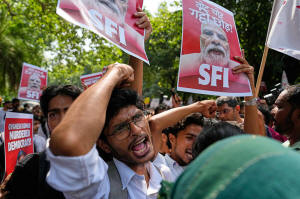
Socialist, left-wing parties and student activists shout slogans
during a protest against Chief Election Commissioner Gyanesh Kumar
and calling for the suspension of the Special Intensive Revision
(SIR) of electoral rolls in New Delhi, India, Friday, Oct. 2, 2026.
(AP Photo/Manish Swarup)

Known as Special Intensive Revision, the revisions have drawn
criticism over the documents required to establish voters’
eligibility. Critics say the requirements have been confusing and
difficult for many voters to meet, potentially leaving millions off
the registration lists and unable to vote.
Election Commission data shows voter lists in some regions could
shrink by as much as 30%.
The commission says the objective is to remove duplicate and
ineligible entries while ensuring eligible voters remain on the
lists. Opposition parties and activists say it risks excluding
legitimate voters. They also accuse the chief commissioner, Kumar,
of political bias and allege the revisions benefit Modi’s party.
The Election Commission and Modi's party have rejected the
allegations.
The ‘Cockroach’ movement is expanding its political focus
The youth movement, which emerged earlier this year out of anger
over high unemployment among young people and leaked examination
papers, has grown into a political force.
Led by Abhijeet Dipke, it rose to national prominence after
organizing mass protests over examination paper leaks. The
demonstrations culminated in the resignation of India’s education
minister, a significant political setback for Modi’s government.
The movement has since sought to take up other issues beyond
education, including government accountability and democratic
institutions.
All contents © copyright 2026 Associated Press. All rights reserved |