Nobel medicine prize goes to 3 scientists for research into brain
activity
[October 05, 2026]
By KOSTYA MANENKOV and STEFANIE DAZIO
STOCKHOLM (AP) — The Nobel Prize in medicine was awarded Monday to Karl
Deisseroth, Peter Hegemann and Georg Nagel for their research into
light-gated ion channels and optogenetics.
The prize was announced at the Karolinska Institute in Stockholm,
kicking off Nobels week.
The prize money this year is 12 million Swedish kronor (about $1.2
million).
Their work was lauded by the committee “for discoveries leading to
optogenetics, which makes it possible to switch on, or off, the activity
of individual nerve cells in a living brain.”
“This method is now being used in laboratories around the world to
reveal the brain’s mysteries,” the committee wrote on social platform X.
Last year, three scientists won the Nobel Prize in medicine for
discoveries about how the immune system knows to attack germs and not
our own bodies. The work by Mary E. Brunkow, Fred Ramsdell and Dr.
Shimon Sakaguchi uncovered a key pathway the body uses to keep the
immune system in check, called peripheral immune tolerance.
Experts called the findings critical to understanding autoimmune
diseases such as Type 1 diabetes, rheumatoid arthritis and lupus.
[to top of second column]
|
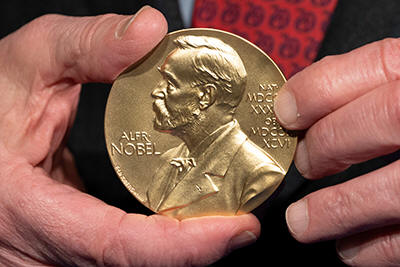
A close-up view of a Nobel Prize medal at the National Institutes of
Health (NIH) in Bethesda, Md., Dec. 8, 2020. (AP Photo/Jacquelyn
Martin, File)
 Monday's medicine prize is followed
by the physics prize on Tuesday, chemistry on Wednesday and
literature on Thursday.
After Friday’s peace prize is awarded, the Nobel Memorial Prize in
Economic Sciences will be announced on Oct. 12.
The prize money this year is 12 million Swedish kronor (about $1.2
million), whether for an individual, small group of laureates or
organization.
___
Dazio reported from Berlin.
All contents © copyright 2026 Associated Press. All rights reserved |