DNA and vehicle-tracking help French investigators recover stolen
Renoirs and makes arrests
[October 13, 2026]
By SYLVIE CORBET and EVA VAN DAM
NANTERRE, France (AP) — DNA left on a protective painting cover helped
investigators recover two stolen Renoirs and uncover what they suspected
were preparations for another art heist, a French prosecutor said
Monday.
Four men were given preliminary charges in the investigation into the
Sept. 8 theft from the small Renoir Museum in the town of Cagnes-sur-Mer
on the French Riviera. The charges include organized theft and criminal
association, Marseille prosecutor Nicolas Bessone said.
One painting, “Portrait of Madame Colonna Romano,” suffered a tear. The
other, “Young Woman at the Well,” had slight damage to its frame,
Bessone said. He estimated their combined value at 4.2 million euros
($4.7 million).
The thieves used an electric saw to cut through a fence, entered the
museum through the ground floor and cut clips securing the frames of
four paintings. An alarm sounded and police officers arrived four
minutes later, a swift response that “apparently caused the perpetrators
to panic,” Bessone said.
"As they fled, they were unable to take all four paintings and abandoned
two of them, which were later found in a protective sleeve,” he said.
Vehicle tracking led to the suspects
The DNA found on the abandoned cover matched that of a 29-year-old
already under investigation in a drug trafficking case in which police
were tracking his vehicle, Bessone said.
Vehicle-tracking data showed that the suspect, accompanied by a
41-year-old man, went to the home of a third man shortly after the
theft, Bessone said.

Police surveillance also showed that the 29-year-old on Oct. 3 visited
the Maeght Foundation in Saint-Paul-de-Vence — home to a large modern
art collection.
The suspect then met with a fourth man known to police from art theft
and forgery cases in 2001 and 2003.
Bessone said the arrests were prompted by the “very strong suspicion
that another heist was imminent.”
The paintings were hidden behind a wall
The two men suspected of carrying out the museum theft have been given
preliminary charges of “theft committed by an organized gang” and
“criminal association,” among other counts. They were sent to prison
pending further investigation. The have denied wrongdoing, Bessone said.
[to top of second column]
|
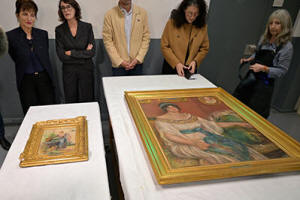
Recovered paintings "Portrait of Madame Colonna Romano", right, and
"Young Woman at the Well," stolen from the Renoir Museum in
Cagnes-sur-Mer are on display at the Interdisciplinary Centre for
the Conservation and Restoration of Heritage in Marseille, France,
Monday Oct. 12, 2026. (AP Photo/Philippe Magoni)
 The third suspect acknowledged
receiving the paintings at his home and hiding them behind a wall
built beneath a staircase after the theft. Investigators recovered
the Renoirs from the hiding place, Bessone said.
The fourth suspect acknowledged seeing photographs of the paintings
but said he did not immediately recognize them. Both of those
suspects were given preliminary charges of “concealment” of stolen
paintings. They were released under judicial supervision and barred
from leaving France.
Two additional people who had been arrested were released without
charge.
The theft renews concerns about museum security
The Renoir Museum occupies the final home of the leading French
Impressionist painter Pierre-Auguste Renoir, who lived there until
his death in 1919. It is the best-known attraction in Cagnes-sur-Mer,
a Mediterranean coastal town between Cannes and Nice.
The theft revived painful memories of the spectacular theft of crown
jewels from the Louvre Museum in Paris last year and renewed calls
for better security and funding at the many cultural sites across
France.
Christian Sainte, national director of judicial police, said Monday
that the country “is repeatedly targeted by organized criminal
groups that carry out theft operations targeting valuable objects
that are part of our cultural heritage” in museums, castles, places
of worship, private homes and art galleries.
French museums recorded 23 cases in 2025 and about 10 this year, he
said.
___
Corbet wrote from Paris.
All contents © copyright 2026 Associated Press. All rights reserved |