UK bookstores scramble as Sally Rooney's novels are withdrawn because
she supports Palestine Action
[October 16, 2026]
By JILL LAWLESS
LONDON (AP) — British booksellers are caught up in a battle over
terrorism and free speech after Irish novelist Sally Rooney said her
books can no longer be sold in the U.K. because she financially supports
the banned group Palestine Action.
The announcement by Rooney’s British publisher that it will no longer
distribute her books has reignited debate over the U.K. government’s
decision last year to outlaw the direct-action protest group as a
terrorist organization. The ban makes membership in or support for
Palestine Action a crime punishable by up to 14 years in prison.
Rooney is a best-seller and a supporter of the Palestinians
Rooney, 35, is the critically praised author of four novels:
“Conversations with Friends,” “Normal People,” “Beautiful World, Where
are You” and “Intermezzo.” Her books have sold millions of copies, and
both “Conversations with Friends” and “Normal People” were adapted for
television by the BBC.
She supports the Palestinian-led Boycott, Divestment and Sanctions
movement, which calls for boycotts of Israeli businesses, universities
and cultural institutions over Israel’s treatment of the Palestinians.
Israel views the movement as an attack on the legitimacy of the Jewish
state.
After the U.K. banned Palestine Action in July 2025, Rooney said she
would use proceeds from her books and their TV adaptations to support
the group. On Wednesday her U.K. publisher, Faber, said that paying her
royalties could violate the terror ban and it had “taken the decision
that we can no longer supply her works in the U.K. in any format.”

It said the decision had been made with Rooney's agreement.
“I have made every effort to be honest with the public about my beliefs
and intentions, and I am wholly prepared to accept the consequences,”
the writer said in a statement.
Bookshops are hit by the fallout
Faber’s announcement left British bookstores scrambling to understand
whether they were breaking the law by selling Rooney’s books.
The Booksellers Association later said it had “confirmed with Faber that
whilst those titles are no longer available to U.K. bookshops to order,
they can continue to sell their existing stock within the U.K. market.”
Some stores rushed to stock up on Rooney’s novels, but found
distributors had already run out.
“We were thinking, we’ll just get a whole bunch before we stop being
able to,” said Lucy Burke, a bookseller at London’s Camden Town
Bookshop. “Because she’s a hugely popular seller here, and quite
evergreen. But now it seems like what we have is all we’re going to
have.”
Burke described the situation as “absolutely ridiculous” and said it
amounted to censorship of “one of our most prominent writers.”
UK says Palestine Action backs violence
Palestine Action, founded in 2020, aims to stop U.K. military support
for Israel, which it says is committing genocide against the
Palestinians – a claim Israel strongly denies.
The group says it aims to stop genocide by disrupting “corporate
enablers of the Israeli military-industrial complex.”

[to top of second column]
|
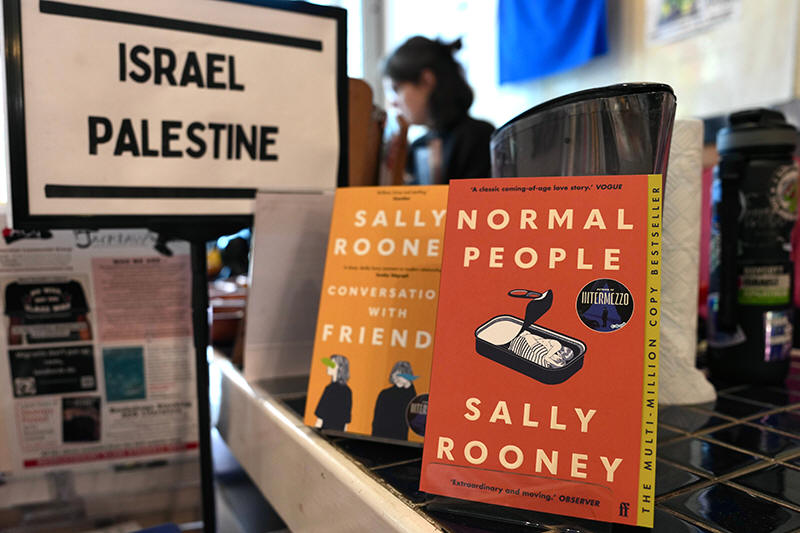
Sally Rooney's books are displayed for sale at a bookshop in London,
Thursday, Oct. 15, 2026. (AP Photo/Kin Cheung)
 In 2024 its activists broke into a
factory owned by Israeli weapons manufacturer Elbit Systems UK,
smashing equipment with sledgehammers and crowbars. The next year,
activists broke into a Royal Air Force base in June 2025, sprayed
red paint into the engines of two tanker planes and caused further
damage with crowbars.
The group says it does not advocate violence
against people, but a police officer suffered a fractured spine when
she was hit with a sledgehammer during the factory break-in.
The British government says Palestine Action has “carried out acts
of terrorism, celebrated those who took part in them and promoted
the use of violence."
“The proscription of Palestine Action does not affect lawful protest
in support of the Palestinian cause, which remains a fundamental
democratic right,” the Home Office said in a statement.
The battle over the ban is heading to the UK’s top court
Civil liberties groups say the ban unjustifiably restricts the
rights to protest and free speech. In response to the government’s
decision, thousands of people have tested the law by silently
holding signs reading “I support Palestine Action.”
More than 3,000 people have been arrested, and more than 1,200 have
been charged under the Terrorism Act, though no one has yet been
convicted.
The scale of the arrests, and the profile of those detained –
including retirees in their 80s and 90s – has put Britain’s Labour
Party government under pressure.
The center-left government has tried to rebuild bridges with
pro-Palestinian supporters since Prime Minister Andy Burnham
replaced Keir Starmer in July.
Last month the U.K. formally recognized a Palestinian state and
banned goods from Israeli settlements in the occupied West Bank.
Foreign Secretary Ed Miliband said his message to people “moved and
outraged by the plight of the Palestinian people” is “We hear you.
You were right.”

The government has not lifted the ban on Palestine Action, however,
and the group continues to challenge its proscription in court.
The High Court ruled in February that classing Palestine Action as a
terror group alongside the likes of al-Qaida and Hamas was
disproportionate and unlawful. The Court of Appeal overturned that
decision in June, saying outlawing the group was “justified and
proportionate.”
Next month the group’s lawyers will ask the country’s top court, the
U.K. Supreme Court, to quash the ban.
John Clegg, a bookseller at the London Review Bookshop, told The
Guardian that Rooney’s stance could help in changing the law.
“Good on her for taking a stand, it seems a ridiculous law. If this
thing convinces the Home Office to move faster to get rid of it, I’m
all for it.”
All contents © copyright 2026 Associated Press. All rights reserved |