A new Medicare season begins, but some shifts will arrive in 2027
[October 16, 2026]
By FATIMA HUSSEIN
WASHINGTON (AP) — Open enrollment for Medicare plans begins Thursday and
enrollees will face a slew of changes that go into effect in 2027.
During the enrollment period, which ends Dec. 7, people will have the
opportunity to choose between traditional Medicare and privately run
Medicare Advantage plans in their area, as well as prescription drug
plans. Those changes go into effect on Jan. 1.
Open enrollment also comes as inflation adds pressure on seniors whose
healthcare costs have risen and as midterm elections are weeks away.
Voters have consistently said that the cost of living is a major concern
heading into the elections.
The Medicare enrollment period also comes as the Social Security
Administration announced Wednesday that the annual cost-of-living
adjustment for older adults and people with disabilities will go up by
3.6% beginning in 2027, which translates to $75 extra per month for the
nearly 72 million people who receive monthly Social Security benefits
and about 7.3 million beneficiaries who get Supplemental Security
Income.
New changes to Medicare coming in 2027 include higher Part D
out-of-pocket caps, the end of temporary federal Part D premium
subsidies, and new drug price negotiations.
Juliette Cubanski, director of KFF’s program on Medicare policy, said
the open enrollment period offers enrollees “an opportunity to evaluate
the coverage they have and see if there might be better options for them
in terms of accessing the care that they need at possibly a lower cost.”
Here are a few of the biggest changes:

Medicare Part D
The cap on annual out-of-pocket expenses for Medicare Part D drugs will
increase to $2,400, up from $2,100 in 2026, and the standard deductible
will increase from $615 to $700.
The temporary Part D premium subsidy will also end early.
The Trump administration concludes at year’s end a temporary Medicare
Part D subsidy program that has helped offset premiums.
It was initially implemented by former President Joe Biden's
administration in 2024 to lower patients’ Medicare Part D prescription
drug costs in response to the effects of the 2022 Inflation Reduction
Act.
The Centers for Medicare & Medicaid Services has projected only modest
price increases for most people. CMS did not respond to an Associated
Press request for comment.
David Lipschutz, co-director of the Center for Medicare Advocacy, points
out that there could be greater disruptions in coverage for some
Medicare enrollees since some Medicare Advantage plans are pulling out
of specific geographic areas and scaling back benefits, such as dental
coverage, while potentially increasing cost-sharing.
Plans, insurance companies make business decisions about what they’re
going to offer the following year, if they’re going to offer anything at
all. And by that very nature, it causes disruption to the system. And it
looks like this time there’s more disruption than usual.
[to top of second column]
|
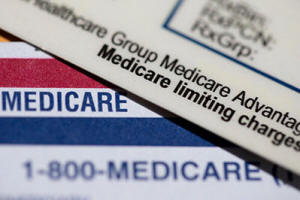
A Medicare Advantage PPO card rests on top of a Medicare card in
Portland, Ore., June 10, 2024. (AP Photo/Jenny Kane, File)
 Drug price negotiations
New Medicare-negotiated prices, part of a Biden-era law that allows
the haggling for Medicare, will go into effect for 15 drugs,
including weight-loss and diabetes medications Ozempic, Rybelsus and
Wegovy.
Additionally, Trelegy Ellipta, Xtandi, Pomalyst, Ibrance, Ofev,
Linzess, Calquence, Austedo/Austedo XR, Breo Ellipta, Tradjenta,
Xifaxan, Vraylar, Janumet/Janumet XR, and Otezla will be covered by
Medicare as of Jan. 1.
CMS expects the change to lower prescription drug coverage for
people enrolled in Medicare by $685 million in 2027.
AARP’s Executive Vice President and Chief Advocacy Officer Nancy
LeaMond said in a statement that “higher healthcare costs are making
it harder for older Americans to afford the care they need."
“It’s more important than ever to shop around, compare your options,
and choose the coverage that’s best for you," she said.
Other Trump administration promises
Along with the changes, President Donald Trump in recent weeks made
a series of promises to Medicare enrollees and retirees.
Last week, Trump said his administration will make one-time payments
of $90 per person in October to help more than 20 million Medicare
enrollees — or less than one third of enrollees — pay for their Part
B premiums. It will cost about $2 billion.
Not eligible are roughly 35 million Medicare Advantage enrollees,
millions of other people with disabilities and low-income Medicare
recipients.
According to the CMS website, eligible beneficiaries will receive
one $90 rebate this month, with most getting a direct deposit.
Others will receive a paper check from the Treasury Department later
in October.
Trump also announced recently that roughly 1 million people would
get rebate checks of $500 for Affordable Care Act premiums.
All contents © copyright 2026 Associated Press. All rights reserved
 |