Amputations and cancer treatment delays: Lawmakers hear testimony on
Mississippi prison healthcare
[October 17, 2026]
By MICHAEL GOLDBERG and GWEN DILWORTH/Mississippi Today
From prisoners suffering amputations due to diabetes to a mother taking
desperate measures to help her incarcerated son treat his debilitating
pain, Mississippi lawmakers on Thursday heard stunning testimony in a
more than three-hour hearing about inadequate healthcare in state
prisons.
Lawmakers presiding over a joint meeting of the House and Senate Public
Health and Corrections committees peppered the CEO of Mississippi’s
prison medical contractor, Kansas-based VitalCore Health Strategies,
with questions about allegations of systemic failure to stop preventable
deaths and illness. Their questions stemmed from stories that have
poured in from their constituents, journalists and legislative watchdog
reports.
Lawmakers also condemned the absence of the Mississippi Department of
Corrections at the hearing, despite having sent the agency a letter
urging its officials to attend.
The hearing came after Mississippi Today’s Behind Bars, Beyond Care
series documented potentially thousands of prisoners with untreated
hepatitis C and others having trouble getting cancer screenings. The
series documented numerous cases of alleged neglect, including delayed
care of an inmate leading to death, a prisoner’s untreated broken arm
forcing an amputation, and prison officials communicating their dismay
at an inmate’s rotting leg going untreated.
Lawmakers, led by House Corrections Chairwoman Becky Currie, a
Republican from Brookhaven, proposed several measures earlier this year
to improve prison healthcare and create stronger safeguards against the
denial of care, but most of the proposed reforms died.
The Thursday hearing centered on some of the problems the bills sought
to correct as lawmakers expect to propose more reforms for the state’s
troubled and expensive prison healthcare system next year.
Lawmakers on Thursday heard about:
Alarming delays in cancer diagnosis and treatment
Dr. Jacob Graham, an oncologist at South Central Regional Medical Center
in Laurel, said he has been alarmed by the significant delays in
diagnosis and treatment faced by his patients who are incarcerated in
MDOC facilities.
One patient he described did not receive a prostate cancer diagnosis
until the disease spread to his bones and caused permanent paralysis of
his lower body due to compression of the spinal cord.

Another waited nearly a year to receive prostate cancer treatment after
a blood test showed dangerously high levels of a protein measured to
screen for the disease. The test in fall of 2025 showed a
prostate-specific antigen of 60 — significantly higher than the normal
range of zero to four — but he did not receive a biopsy until April
2026, and did not begin treatment until August. Graham said it was
“miraculous” the cancer had not metastasized in spite of the significant
treatment delay.
Yet another patient with lung cancer that had spread throughout his body
received treatment at the University of Mississippi Medical Center and a
dire prognosis of weeks to a few months to live. But prison medical
staff did not arrange for him to visit a local oncologist within a week
as ordered, leaving him to languish for over a month before receiving
follow-up care as his condition deteriorated. He was then hospitalized
again due to complications associated with the delays in care.
Limb amputations and trip to a Motel 6
Multiple state lawmakers relayed stories of constituents who suffered
amputations due to untreated diabetes in prison.
Limb amputations are a serious complication of diabetes, though a
majority of diabetes-related amputations are preventable, according to
the Centers for Disease Control and Prevention.
Rep. Elliot Burch, a Republican from Lucedale, testified that he
received a call a year and a half ago informing him that a constituent
with serious medical concerns had been released from prison to a Motel 6
on I-55 in Jackson, even though MDOC staff previously told his family
they planned to refer him to long-term care.
Burch, initially skeptical of the story, decided to investigate himself.
He traveled to the motel, and after he knocked on the man’s door, he
found him with both legs amputated, unable to get out of bed himself to
unlock the door. At least one of the amputations occurred while the man
was in MDOC custody due to uncontrolled diabetes.
The man had been dropped off with insulin, but no blood glucose monitor.
And the only food he had to eat was a bag packed with carbohydrate-rich
foods, including crackers and sandwiches. The man ultimately had to seek
emergency care for another issue and was discharged to long-term care
from the hospital.
Rep. Steve Lott, a Republican from Lucedale, said he received a call
from a constituent set to be released from South Mississippi
Correctional Institution in Leakesville with serious health issues,
including diabetes. Three days after the man was paroled from prison,
his leg was amputated.
A mother takes desperate measures to help treat her son’s chronic
pain
Pearly White said she almost lost her home from sending money to the
prison where her son was incarcerated after he lost access to critical
medication.
She went on to tell lawmakers about a scheme where fellow prisoners,
under the watch of guards, coerced her to pay them an ever-increasing
sum of money for illegal drugs to help her son manage pain medical
officials failed to manage.
“She’s been extorted,” Currie said.
White’s son was an amputee when he went to prison, spending time at the
Mississippi State Penitentiary at Parchman and Marshall County
Correctional Facility after multiple DUI charges. He had spinal cord
damage, a condition he managed with gabapentin, a prescription
nerve-pain medication. The problems began when prison officials told him
they couldn’t provide him with the drug.

He couldn’t function, she said, and desperate to manage the debilitating
pain, he turned to marijuana. In a plea to help her son, White
transferred money to people inside the prison through an app. She could
afford the payments at first, but they eventually ratcheted up the price
to over $1,000, threatening to cut off her son.
“They know what they’re doing,” White said. “They have help. The
officers, they know.”
White, a veteran who works as a surgical technician in Oxford, said she
has plunged into debt trying to get her son treatment he should have
received through the state’s prison medical contractor.
“I stand up on this bad back and these bad knees every day so that I can
pay the bills that I acquired from the inmates, because VitalCore didn’t
think it was necessary that he have gabapentin,” White said.
[to top of second column]
|

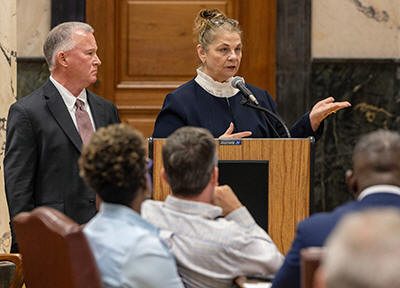
Viola Riggin, co-founder and CEO of VitalCore Health Strategies, and
Bryan Collier, the company's executive operations adviser, speak to
members of the Senate Public Health and Welfare Committee and the
House Corrections Committee during a joint meeting at the Capitol in
Jackson on Thursday, Oct. 15, 2026. (Eric Shelton/Mississippi Today
via AP)
 White’s son was eventually released
from prison and now lives with her.
White said she reported the scheme to MDOC’s Corrections
Investigation Division and the FBI. She’s received no word from
either entity about whether they investigated her case or the
illicit flow of money into prisons.
VitalCore responds: ‘I think it’s time to tell our story’
After over an hour of testimony from speakers outlining a wide range
of prison healthcare woes, VitalCore’s leader spoke for the first
time to lawmakers.
Beth Clay, VitalCore’s lobbyist in Mississippi, introduced her
client in soaring terms.
“I’m telling you, the people I’m bringing you today have hearts of
gold when it comes to medical care,” Clay said.
Viola Riggin, the company’s founder and CEO, said she doesn’t like
the limelight, but feels her company’s work has been misrepresented.
“I think it’s time to tell our story,” she said.
Before addressing the issues raised by those who testified, Riggin
described her humble beginnings in Kansas, where she began her
career working in correctional facilities when she was 19. She and
Dr. Lorelei Ammons founded VitalCore in 2018, and the company
developed a reputation for providing medical care to places in
crisis, she said.
Riggin then extolled her company’s management of prison healthcare,
distributing a packet with statistics she said show VitalCore has
made progress improving outcomes inside state prisons.
She said she was met with a “dire” state of care in 2020 when
VitalCore was awarded an emergency contract to provide medical care
in Mississippi prisons after the previous company terminated its
contract. VitalCore was awarded over $315 million in emergency,
no-bid state contracts from 2020 to 2024. The state selected the
company for a three-year contract worth over $357 million in 2024.
She described a dearth of medical staff, patients not receiving
annual physicals, HIV going untreated and six years in which
patients did not receive mammograms to detect breast cancer.
“The care was not appropriate, and it was not OK,” she said.
She claimed that many of the current challenges facing medical care
are residual effects of previous contractors’ impropriety.
For example, Riggin said, reaching contractually obligated staffing
levels took time, though the company is now better meeting the
requirements. And as for allegations that VitalCore has delayed
payments to vendors are vestiges of past contractors’ behavior — she
said the company pays bills within 90 days.
Dispute over hepatitis C treatment
VitalCore has drawn criticism for treating only a handful of the
hundreds of people in MDOC diagnosed with hepatitis C.
Brian Collier, VitalCore’s executive operations advisor and former
executive director of the Texas Department of Criminal Justice, said
the company is treating 50 patients diagnosed with hepatitis C each
quarter.
At this rate, he said the company will by 2029 cure over 700
patients identified with the disease in 2024. This does not include
new people who enter the facility or contract the contagious illness
while incarcerated.

Currie questioned those numbers, citing conversations she had with
Corrections Commissioner Burl Cain and Dr. Raman Singh, VitalCore’s
chief medical officer, where they purported many more people
incarcerated in MDOC facilities had tested positive for the illness.
“When I first became chair, when Burl and I actually got along, we
had many, many discussions, and he told me that over 5,000 inmates
had hep C,” Currie said. “Somebody is not telling the truth.”
Hepatitis C is a blood-borne infection that can be cured in more
than 95% of cases with an eight- to 12-week course of medication,
though it is costly.
State Health Officer Dr. Dan Edney said treating a fixed amount of
hepatitis C patients a year is “unacceptable,” noting that the
standard of care is to universally screen for the highly contagious
infection and treat it immediately.
“If you don’t, with a confined population, you will have reinfection,”
said Edney.
Edney said he could help the company access medication at lower cost
through a federal program. Mississippi Today reported in 2025 that
the Department of Health provided MDOC information about how to
access the discounted prices, but the agency did not take steps to
do so.
A notable no-show
Even as they probed VitalCore’s leaders and questioned some of their
assertions, lawmakers commended the company for at least showing up.
The same could not be said for the agency that hired them: MDOC. On
Monday afternoon, lawmakers learned that MDOC officials, most
notably Cain, planned to skip the hearing over the problems that
have unfolded on their watch.
On Tuesday, the chairs of the Public Health and Corrections
committees sent Cain a letter urging him to reconsider. But their
overtures apparently fell on deaf ears, as Cain and agency leaders
didn’t show up.
MDOC did not provide lawmakers with an explanation for their
absence, and the agency did not respond to a request for comment
from Mississippi Today.
“So they just didn’t want to stop to sit and talk to legislators, I
guess,” said Sen. Jeremy England, a Republican from Vancleave. “It
sounds like they’ll be OK with whatever we do then if they don’t
care to be here to listen.”
Rep. Chris Bell, a Democrat from Jackson, said he believes the joint
committee should demand Cain come before it to answer questions.
“To hear the testimony of all the individuals that we’ve heard today
and for him to have the audacity not to show, not to designate
someone to come is totally disrespectful,” Bell said. “This is
unacceptable.”
All contents © copyright 2026 Associated Press. All rights reserved |