Iran war votes in Congress become a focal point for campaign ad attacks
[October 17, 2026]
By KEVIN FREKING and AARON KESSLER
WASHINGTON (AP) — In Wisconsin, a narrator complains that “groceries,
utilities, everything's getting more expensive and Congressman (Derrick)
Van Orden is adding to the list. He voted for the costly Iran war and
spiking gas prices."
In Nebraska, Democratic candidate Chris Backemeyer says families are
drowning. “And Mike Flood opened the gates. Flood voted six times for
Trump's tariffs and the Iran war, flooding us with higher prices on
groceries, gas, cars and medicine, costing us a thousand dollars more a
year.”
And in Iowa, a group called Vote Vets Action Fund said Republican Senate
candidate Ashley Hinson voted five times for the Iran war, “giving us
record prices for gas and fertilizer.”
Those ads are but a few examples of how Democrats and aligned advocacy
groups are using an unpopular war as they challenge Republicans, aiming
to win back power in the House and Senate. It's the culmination of a
strategy Democrats launched in the spring, when they began to repeatedly
bring up war powers resolutions aimed at ending the conflict. The votes
had little practical effect, but forced lawmakers to go on record and
take a stand.
Now those votes are being highlighted in campaign ads across the
country, according to an Associated Press analysis of data from AdImpact,
which charts media spending.
In some cases, the Republicans targeted have never served in Congress
before, so they couldn't possibly have voted on the various war powers
resolutions. Even then, Democrats are portraying them as destined to be
rubber stamps for President Donald Trump when it comes to the war.

Tying the war to the cost of living
The Associated Press analyzed data on broadcast and cable ads aired from
Sept. 1 through Oct. 14 in the most competitive midterm races. The
analysis focused on House and Senate races rated as either tossups or
leaning Democratic or Republican by the Cook Political Report. A smaller
number of streaming ads were also examined.
At least half of the 50 races featured Iran-related ads, most of which
included household cost-of-living messages. All told, the ads aired on
TV more than 43,000 times since Sept. 1, costing an estimated $42
million. The AP used both AdImpact’s own issue designations along with
additional analysis of the ads’ language to identify them.
Of the 65 unique Iran-themed ads identified by the AP, 61 of them
stressed household cost-of-living messages such as rising prices for
fuel and other items.
The Republican playbook
Republicans are largely ignoring the Iran war in their ads. Their best
strategy is to go after Democratic weaknesses so voters say “this guy is
worse,” said Ron Bonjean, a Republican strategist.
“In the end, you're trying to get as many Republicans out to vote for
you as possible and bring over some independents," Bonjean said. “And
talking about the Iran war is really not a winning message because
you're playing on the Democratic turf.”
The major themes addressed in the Republican advertising since Sept. 1
are taxes and crime, followed by issues tied to character, healthcare
and immigration.
Some Republicans have sought to distance themselves from the Iran
conflict outside the airwaves. In Michigan, Republican Senate candidate
Mike Rogers has said the “war with Iran needs to end — and end quickly.”
His opponent, Democratic nominee Abdul El-Sayed, has run ads saying that
a billion dollars a day is going to a war “we have no business fighting”
and he was running to “invest our tax dollars here in Michigan.”
[to top of second column]
|
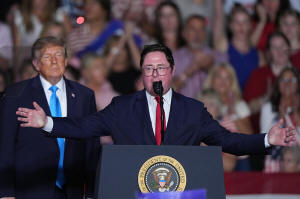
President Donald Trump listens as Rep. Mike Flood, R-Neb., speaks at
a campaign rally at the Pinnacle Bank Expo Center, Monday, Oct. 5,
2026, in Grand Island, Neb. (AP Photo/Charlie Riedel)

In Maine, Republican Sen. Susan Collins emphasized in a recent
debate that she voted nine times to end the conflict, prompting
Democratic challenger Troy Jackson to say she voted five times to
“make it happen.”
In all, the Senate has voted 14 times on resolutions seeking to halt
or restrict Trump's military action against Iran. The House has held
six such votes since the conflict began in late February.
In the latest House vote, seven Republicans ended up siding with
Democrats in voting to end the war. That includes four Republicans
seeking reelection in highly competitive districts: Tom Barrett of
Michigan, Brian Fitzpatrick of Pennsylvania and Mariannette
Miller-Meeks and Zach Nunn in Iowa. Barrett and Fitzpatrick had
voted previously to remove U.S. troops from hostilities, but the yes
votes were the first for Miller-Meeks and Nunn, reflecting the
growing weariness with the war.
Where Iran ads are most prevalent
While the Iran war ads made up about 5% of the total TV spots aired
across the competitive races, some contests leaned into the topic
heavily. The highest concentration was in California’s 48th
Congressional District in the San Diego area.
Roughly a third of the 12,000 aired ads touch on Iran. Democrats are
seizing on a remark that Republican Jim Desmond made in the early
days of the war, in which he said “no pain, no gain” as part of an
interview on Real America's Voice. He also said in that interview he
believed the higher prices were just “a spike” and would come down
once the U.S. eliminated Iran's nuclear capability.
“No pain, no gain?" asks an ad from Democratic candidate Marni von
Wilpert. “Tell that to a family filling up their gas tank.”
Desmond and the National Republican Congressional Committee
responded with an ad that doesn't mention Iran but criticizes von
Wilpert for raising taxes and fees when she was on the San Diego
City Council. In contrast, the ad says Desmond fought to lower costs
and supports suspending the gas tax.
Not far behind in Iran-related ads are Virginia’s 2nd Congressional
District, now held by Republican Rep. Jen Kiggans, and Maine’s 2nd
Congressional District, an open seat. Roughly a quarter of the ads
in those districts touch on Iran. Both are highly competitive races.
Meanwhile, some 4,000 Iran-themed ads have aired in Ohio, or about
4% of the total in one of the nation's most expensive contests.
Nearly all were from Democrat Sherrod Brown's campaign and leaned
heavily on pocketbook themes.
All contents © copyright 2026 Associated Press. All rights reserved |