Congo’s fast-moving Ebola outbreak spreads to eighth province
[October 19, 2026]
The Ebola outbreak in Congo has reached an eighth province in the
country’s north, authorities said on Sunday as the spread of the world’s
fastest-growing outbreak of the disease on record continues to outpace
response efforts.
The Health Ministry has recorded two cases, including one death, in
Nord-Ubangi province, bordering the Central African Republic. The
ministry said both patients were men in their 20s living in the Wapinda
health zone, which borders Bas-Uele province, where Ebola cases have
been reported previously.
Authorities have recorded at least 9,400 cases, including over 4,500
deaths, in the outbreak declared in mid-May, making it the deadliest in
Congo’s history.
The virus has spilled over into other countries including neighboring
Uganda, which has since declared itself free of the disease, and Kenya,
which recorded a seventh case on Saturday. The Central African Republic
has not recorded any confirmed cases.
“We see pockets of Ebola generally going down, but unfortunately
geographically it’s spreading out,” World Health Organization Regional
Director for Africa Mohamed Yakub Janabi told The Associated Press in an
interview in Beni, eastern Congo, on Friday.
Janabi said one of the biggest challenges has been convincing those who
are infected to seek medical assistance, adding that some deaths occur
in the community outside of health centers.

Serge Ngalebato, epidemiologist and field coordinator for the Wamba
health zone in Haut-Uele province, told the AP health workers in his
health zone introduced periodic home visits because people were too
afraid to go to hospital.
Nord-Ubangi is located between Sud-Ubangi and Bas-Uele, the last two
provinces the disease had spread to along the border with the Central
African Republic, where recurring armed violence has forced thousands to
flee and take refuge in Congolese border communities. Access in the
region can be difficult due to poor roads and limited communication
networks.
Ituri province in eastern Congo remains the disease's epicenter,
accounting for almost three quarters of confirmed cases, according to
the government’s most recent data, which shows 66 health zones have been
affected since the start of the outbreak.
[to top of second column]
|
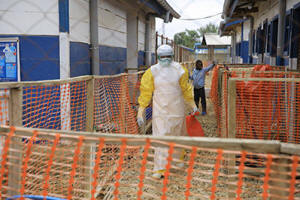
A healthcare worker walks inside a treatment center for Ebola
patients in Beni, North Kivu province, eastern Congo, Wednesday,
Oct. 7, 2026. (AP Photo/Sebastien Kitsa Musayi)
 Congo's state-news agency ACP
reported Sunday that authorities in North Kivu province - where WHO
says substantial transmission continues - will introduce a one-week
ban from Monday on people entering the province from Ituri in an
effort to slow the spread of the virus.
Other measures that will be introduced include prohibiting carrying
more than two people on a motorcycle or four people in a car, as
well as suspending big public gatherings such as at mass sports
activities, nightclubs and political demonstrations.
The spread of the outbreak, caused by the rare Bundibugyo virus for
which there is no approved vaccine or treatment, is fueled by mass
population movements, rebel violence, mistrust and poor working
conditions of front line workers.
Ngalebato said efforts to contain the virus in the Wamba health zone
were initially met with resistance among local residents, but as
time went on the community became more understanding and began
reporting positive cases.
“Ebola is a community disease. If the community does not cooperate,
it will be very difficult,” he said.
He added most of the cases reported in his health zone are around
mining areas where the population moves constantly, so a lot of
deaths were reported in these areas.
——
Saleh Mwanamilongo contributed from Bonn, Germany
All contents © copyright 2026 Associated Press. All rights reserved
 |