She voted for Trump every time. Then came cancer and the bills
[October 26, 2026]
By JESSE BEDAYN
McALLEN, Texas (AP) — The Ford Expedition rumbled to a stop and Cindy
Banda’s bedazzled flip-flops landed on the asphalt of the Houston cancer
center’s vast parking lot. She threaded through the rows of cars, a
tally of patients who gather here to sit with chemotherapy needles or
lie on radiation machines.
The elevator dinged open. A year ago in this building, surgeons removed
Banda’s right breast, and she still didn't know whether treatment had
expunged the cancer from her body. Doctors had told her it would be
tough to beat.
“I’m more of a positive person myself,” Banda said, now sitting with a
white wristband in a dim waiting room. But the bills are harder to
dismiss, and the single mother with six children in her care repeated
something like a mantra. “Keep the house. Keep the cars. And just keep
the kids stable.”
That’s true for many Americans, as rising healthcare costs leave more
families with a sinking feeling after seeing the bill for surgery or
medication. Heading into the Nov. 3 midterm elections, about half of
registered voters said healthcare costs are a major problem for them and
their families, up from a little more than one-third four years ago,
according to a Fox News poll from September.
With party control of Congress at stake, registered voters are nearly
twice as likely to say they trust Democrats over Republicans to handle
healthcare, according to an Associated Press-NORC Center for Public
Affairs Research poll from the same month. Those frustrations, combined
with broader concerns over rising prices, have sapped support for
President Donald Trump and his Republican Party.
Banda knows how that feels. She backed Trump in each of his three
campaigns, motivated by her opposition to abortion. But when cancer
came, the ensuing scramble to make ends meet was painful enough to
rearrange her priorities, and she started to think about voting
Democratic for the first time.
The 46-year-old was ushered into a sterile room for her appointment, her
phone lit up with a text. “Please contact TD Auto Finance.”

“This one’s $1,300,” she said of the car payment bill. “I have to go
back to work.”
She had been on sick leave from her job selling internet service for one
year, and she needed the income to support her three kids and three more
she had taken in after her sister's death.
The doctor said her reconstruction surgery could be scheduled early next
year. “I was hoping for maybe December,” Banda said, “only because I've
met my deductibles.” Come January, she would have to pay down the $7,500
again. Earlier may be possible, the doctor replied, if the skin around
her surgical scar loosens.
The evening had cooled slightly by the time she walked back through the
rows of parked cars, their ebb and flow marking the tide of sickness,
survival and death in a small corner of a colossal healthcare industry
that saves lives while taking in over $5 trillion every year.
Banda paid $8 for parking as she left.
Confronting death and debt in America before a midterm election
Two weeks later, Banda was back at work, making door-to-door rounds to
sell Spectrum's Wi-Fi in McAllen, her city along the U.S.-Mexico border
in the Rio Grande Valley. Banda, holding blue flyers, walked along a row
of storefronts, some that shuttered since she last was in the area.
She hadn't had a sale and commission since October of last year, after
the biopsy and diagnosis.
The doctor who gave her the news had hugged Banda, and she sobbed even
though she never really sobs in front of other people. During chemo, her
children took turns buzzing off her wispy hair. When her 9-year-old
daughter's hand quivered, a teenage cousin helped guide the clipper over
her mother’s scalp.
Banda’s first impulse was to maintain normalcy, stability, for the
children.
But that requires roughly $7,000 a month for utilities, mortgage, car
payments and groceries, along with the two water leaks. Then, even with
insurance through her job, the surgeries, chemo and radiation added up
to over $25,000 that she's been paying off, making Banda one of tens of
millions of other people in the United States in medical debt.
Banda tries not to dwell on death and debt.
“It’ll consume you,” she says. She smothers those thoughts beneath her
bubbly demeanor and avoids being alone. But that truce, between her
insistence on positivity and the fears that it covers, is brittle.
Certain thoughts still arrive uninvited. Banda’s late sister, Melissa,
didn’t have life insurance. Banda makes sure it's a payment she never
misses.
“Sometimes I think, and I shouldn’t think like this, but I’m worth more
gone than here,” she said one day. “Obviously, the goal is not that, the
goal is to beat it,” she continued, “to keep the house and keep the
cars.”
So far she has, with the help of others.
[to top of second column]
|
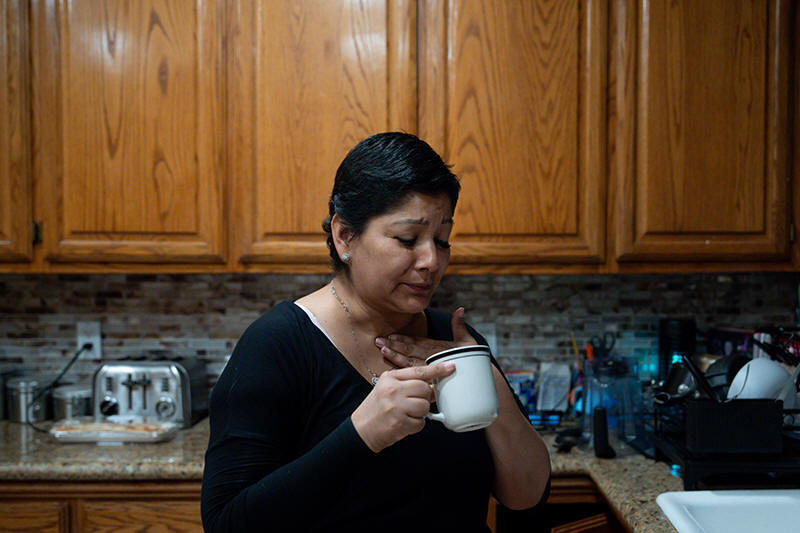
Cindy Banda drinks a home remedy after experiencing side effects
from the targeted therapy pill Kisqali, Sept. 16, 2026, at her house
in McAllen, Texas. (AP Photo/Julia Demaree Nikhinson)

On top of child support, the father of Banda's 9-year-old often pays
$400 a week for a nanny to help with the kids. Banda’s own father sent
her $700 before for her recent Houston appointment, one of his many cash
infusions. Her high school classmates, who she hadn’t been in close
touch with in decades, fundraised by selling grilled chicken, rice and
beans from a roadside tent. Two GoFundMe fundraisers raised nearly
$30,000 and Banda rented her late sister’s house while putting her own
in forbearance.
But months of insecurity takes its own, sleepless toll. She needed to
sell some internet services to catch up.
After sticking the Spectrum Wi-Fi flyers onto empty storefronts, she
drove to pick up her kids from school. The following day she had a
morning meeting at a barbershop for what would be her first sale back at
work.
Turning on Trump and voting Democratic for the first time
A lifelong Christian, Banda had voted her anti-abortion stance in past
elections. When her sister was kidnapped and murdered by her ex-husband
in 2020, Banda retreated from religion. The cancer brought her back to
church with an apology to God, but it also made her rethink her
politics.
She voted for Trump in 2016, and his first four years seemed steady, so
she voted for him again in 2020. Democratic President Joe Biden's
tenure, including the tail end of a global pandemic and rising
inflation, felt like bedlam, so she voted for Trump to return to the
White House in 2024.
But two years later and fighting an expensive disease, she had found no
respite from high prices.
So when James Talarico, a Presbyterian seminary student running for U.S.
Senate as a Democrat, visited one of Banda’s fundraisers — speaking
about his diabetes and his work in the Texas Statehouse to lower the
price of insulin — it moved her. “Imagine if he can do that for the
cancer,” she said.
Talarico and his Republican opponent, state Attorney General Ken Paxton,
have different approaches to healthcare. Talarico wants all Americans to
be able to join Medicare; Paxton proposed a $25,000 tax deduction for
out-of-pocket medical expenses.
Talarico also supports a law guaranteeing abortion access nationwide,
which Banda has voted against for years. But after she slid into debt to
stay alive, after her grocery bills mounted and the high school had to
comp the kids' soccer gear she couldn't afford, Banda’s anti-abortion
concerns have been superseded by costs.
“Because it’s what I’m living,” she said. “I'm living it."
Banda cast an early ballot for Talarico. “Never voted Democrat before
today!!” she wrote in a text with blue heart emoji.
Her news will come on Election Day, in a doctor's office
Banda had just started a new cancer-targeting medication that cost
$16,000 a month, reduced to $500 by insurance. By the afternoon, she was
nauseous and fatigued, unable to eat. The malaise would keep her home
the next day. She would miss the meeting with the barbershop to close
her first deal since getting sick, though she felt confident it was in
the bag.

But Banda pushed through the discomfort one evening to join her family
as they replaced the flowers at her sister's tomb.
She drove past the headstones and oak trees in the evening’s slanting
light, and the family gathered around Melissa Banda's tomb in an
open-air mausoleum. There was no speech. Their eulogy was her father,
Fidel Banda, methodically clipping and arranging the flowers for his
daughter.
Banda walked along the wall of tombs. She will find out on Election Day
whether the cancer is in remission or whether it's spread to her organs.
“This one’s for me,” she said, pointing to a blank tomb next to her
sister's.
“Mom!” said her daughter with the huffiness of a 9-year-old. “Why would
you say that?”
Banda smiled and added, “in a hundred years."
All contents © copyright 2026 Associated Press. All rights reserved |