Dangerous levels of lead and other toxins taint soil at Minnesota
homeless encampment
[October 28, 2026]
By MADDIE ROBINSON and SHAY SCANLAN/MinnPost
Randolph Avenue meets Shepard Road in St. Paul near the banks of the
Mississippi River, hemmed in by railroad tracks still serving the
industrial corridor. Beyond the intersection, nearing the river, a
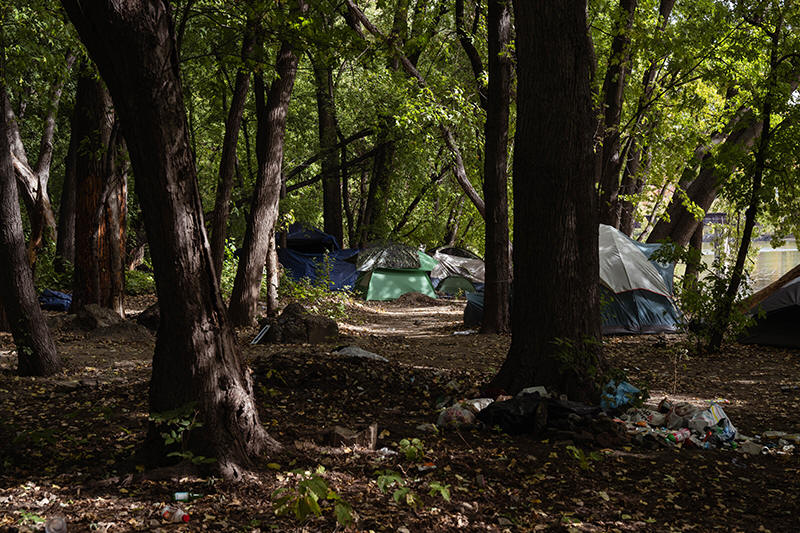
winding network of dirt paths and pitched tents have become a makeshift
neighborhood – St. Paul’s largest encampment – for hundreds of people
without permanent shelter.
Posted around the site are Minnesota Pollution Control Agency (MPCA) “no
trespassing” signs, many of them defaced by graffiti, warning of a stew
of toxins in the soil, including lead, arsenic and mercury. The levels
are so high, the signs say, that the area is listed as one of
Minnesota’s permanent environmental priority sites.
The MPCA has tracked the toxins for years and has labeled the area that
is now home to the encampment as a state superfund site, meaning it is
eligible for state-funded cleanup. (The site is not a
federally-designated Superfund Site.) But while the agency has included
cleanup funds in its budget requests, they’ve been turned down by state
lawmakers in favor of higher-priority projects.
The site has become a perfect storm – land never intended for human
habitation has become a home for people who say they have no place else
to go. And as St. Paul and Ramsey County authorities wrestle with how
and when to rehouse the homeless individuals who live there, the health
impacts mount.
Whose land is it?
Ownership of the land is murky, especially given that the encampment has
no specific boundaries. An MPCA assessment from 2022 shows that at least
part of the land is City of St. Paul parkland and public right-of-way.
Adjacent portions are owned by Xcel Energy and Union Pacific Railroad.

The same assessment reports that from 1968-1989, the area was an
automobile salvage yard whose operator filled the land with soil mixed
with materials like asphalt, glass, wood and plastic in order to raise
the ground level to prevent flooding.
Along with charred automobile parts, construction debris and battery
casing fragments found on the site as deep as 16 feet underground, MPCA
testing done in the early 2010s identified lead and carcinogenic
chemical hotspots.
MinnPost gathered three soil samples at the Randolph encampment in late
September and sent them to University of Minnesota biology researcher
Emilie Snell-Rood, who co-leads a lab studying how urban contaminants
move through the Twin Cities.
Of the three samples, one collected on the outskirts of the encampment
did not show elevated lead levels and another, collected on a main
pathway, showed lead levels at 355 parts per million (ppm). Chronic
exposure to any level above 200 ppm is considered a health risk,
Snell-Rood said.
The third sample, taken near the center of the encampment where some
residents have lived for years, showed lead levels of 646 ppm, well over
triple the safety threshold. At anything above 600 ppm, the U.S.
Environmental Protection Agency (EPA) recommends the removal of soil
from residential areas.
Snell-Rood said she would be “very concerned” for people with daily
interactions with the soil. “If there is exposed soil and people are
walking on it and it gets dusty and they inhale that, or they’re sitting
on the ground and touching it, and it gets on their hands or it gets in
their mouth, those would be the exposure routes I would worry about,”
she said.
The health risks posed by lead depend on factors such as a person’s age,
how the lead is absorbed and how long a person is exposed. Snell-Rood
said with long-term exposure, the human body can confuse lead with
calcium and store it in the bones. This can lead to multiple serious
issues with cognition, executive function, the cardiovascular and
nervous systems and more.
Lead is particularly harmful to pregnant women, as it can enter the
bloodstream and reach the fetus, increasing the likelihood for
miscarriage, premature birth and developmental complications. Vanessa
Rojas, a mutual aid worker who volunteers almost every day at the
Randolph encampment, said she knows of six pregnant women currently
living at the site.

Rojas, who has been visiting the encampment for about a year and is
currently co-founding a nonprofit focused on homeless outreach,
estimates about 50 residents were living at Randolph before St. Paul
officials cleared the Pig’s Eye encampment in early August. Many of the
people forced out moved to Randolph, bringing the population to over 400
people, Rojas said.
St. Paul has offered more conservative estimates of about 150 to 200
residents at any given time, but city spokesperson Matt Wagenius said in
an email to MinnPost on Oct. 23 that the onsite city outreach team is
“tracking work” with about 330 residents.
Health issues and distrust
Following the clearing of Pig’s Eye, the influx of newcomers carting
their belongings and pitching tents kicked up dirt and brought deeper
soils to the surface, Rojas said, leading residents to voice more
health-related concerns.
Dan Campbell has lived at Randolph on and off for about 15 years. Known
as “Luigi,” he is more familiar with the area than anybody, Rojas and
other volunteers said, and has earned the respect of fellow residents.
Campbell needs back surgery and a hip replacement, but he blames the
polluted land for contributing to his worsening respiratory system,
swollen legs and feet injured by debris and irritants.
“My dog’s constantly licking their feet,” Campbell said. “Got something
going on with them because of the soil, too.”
Tiffany Weber, another resident, has lived at the Randolph encampment on
and off for 10 years. She told MinnPost she recalls several instances of
vomiting after lying on the ground – a symptom she thinks could have to
do with the soil health.
She expressed deep distrust of city and state officials, whom she said
have turned a blind eye to people living on the polluted land while
doing little to mitigate the environmental dangers.
“They know that it’s gonna make us sick or perhaps kill us,” Weber said.
St. Paul and Ramsey County officials pushed back, pointing out that
MPCA’s warning signs are posted throughout the area and outreach workers
have been onsite regularly connecting residents with available
resources.
When asked about the contamination, Ramsey County spokesperson Casper
Hill said via email the county knows about the pollution and has
“implemented safety protocols for staff working onsite related to
concerns about soil contamination,” as well as “focused on connecting
encampment residents to benefits, services, and other resources that can
improve their wellbeing and help get them out of the encampment and into
shelter and housing.”
[to top of second column]
|
The Randolph encampment is seen in St. Paul, Minn., on Oct. 8, 2026.
(Bridget Bennett/MinnPost/CatchLight Local/Report for America via
AP)
 Wagenius said in an email to
MinnPost that city outreach staff are onsite “nearly every day”
distributing water, food and other basic necessities, as well as
health supplies like drug testing strips and wound care kits. He
added the onsite teams also help residents get approved for food and
cash assistance programs, like Supplemental Nutrition Assistance
Program (SNAP), perform housing assessments and assist with clearing
warrants.
City outreach staff are encouraged to wear protective gear such as
face masks and disposable shoe coverings when at Randolph due to the
soil conditions, Wagenius said.
“The contamination on this land is a main reason we urged people to
use shelter space rather than move to this location,” the email
said. “The Minnesota Pollution Control Agency posted warning signs
around the site before the encampment formed.”
Competing funding priorities
Though numbers have swelled in recent months, evidence shows people
have lived at Randolph for years. A 2014 Minnesota Department of
Health health assessment sent to an MPCA hydrogeologist noted that a
large tent was set up on the property during a site visit in late
May of that year.
“… It is possible that a person(s) may be living there rather than
just camping for the night. There was no signage to alert people to
the contamination, nor was there signage or fencing to encourage
people to stay off of the property,” the 2014 letter stated.
The City of St. Paul declined to comment further when asked when
they became aware of people living at the site.
The site has been listed as a state superfund site since 1992,
according to MPCA records, following its acquisition by the City of
St. Paul through tax forfeiture. Under state law, polluters are
required to pay for cleanup. But when, as at Randolph, the polluter
is unwilling to cooperate or no longer exists, the state has access
to a “remediation fund” to cover cleanup costs. Seven other St. Paul
sites are on the same “permanent priority” list, including the Pig’s
Eye Landfill which was home to the previous encampment.
In 2016, an EPA evaluation found that the Randolph site, officially
called “St. Paul Levee Site,” needed short-term stabilization and
cleanup. But the site has largely gone untouched since then aside
from soil sample collections and the installation of groundwater
monitoring wells. A 2022 assessment estimated that cleanup,
including excavating the tainted soil, would cost about $4 million,
Ruiter said.

The state’s remediation fund is sizable but not unlimited: In 2022,
the MPCA spent just over $59 million on remediation projects,
according to the agency’s enacted biennial budget. This jumped to
over $111 million in 2024, and the enacted budget for 2027 is
roughly $164 million. Other, smaller funds also are used for various
land cleanup efforts. Ruiter said that MPCA prioritizes projects
based on their risk to human health and the environment.
“The site at Shepard and Randolph does not have buildings or
drinking water sources and has signage to warn people to stay off
the property due to contamination. If followed, this reduces the
risk at the site,” Ruiter said.
In addition to the remediation fund, agencies like MPCA can request
additional dollars through the Legislature’s bonding bills. In 2024,
the MPCA requested $7 million to finalize plans to “excavate,
stabilize, and treat” the majority of the soil at the site. Cleanup
for the Randolph encampment would have begun in 2025 and continued
through 2028, but the funds did not become part of Gov. Tim Walz’s
recommended budget.
Walz’s office did not respond in time to MinnPost’s request for
comment.
Sen. Sandra Pappas (DFL-St. Paul), who chairs the Legislature’s
Capital Investment Committee and whose district includes the
encampment area, said that prior to the closure of the Pig’s Eye
encampment, she was not aware people were living at Randolph Ave.,
nor of its soil conditions.
Oftentimes, she said, legislators learn of issues through advocates
at the local level. City leaders, for example, might make a case to
their legislators for remediation funding or cleanup funding
included in the MPCA’s budget. Then, the legislators might take that
request into budgetary discussions and dealings. In the case of the
Randolph Ave. site, that didn’t happen, Pappas said.
“I certainly haven’t heard from them that, ‘We need help with this.
Can you advocate to put money in the remediation fund?’” Pappas
said. “It’s been kind of a neglected property.”
The City of St. Paul declined to comment when asked if they had
requested funding or advocated for an encampment cleanup.

Council pauses possible closure
On Oct. 21, with winter fast approaching, the St. Paul City Council
took up the question of how the city should respond to encampments.
They unanimously passed a resolution to establish a 60-day pause on
encampment closures and ensure a “navigation tent” onsite to assist
residents. The resolution also established plans for a temporary,
indoor shelter to operate during the winter months and a separate
indoor, permanent shelter.
Dozens of people showed up to the Council meeting to advocate for a
longer pause. Councilmember Saura Jost called the Council’s
resolution a first step.
“We currently have hundreds of residents that are spending their
nights sleeping on contaminated ground, and we know that our first
responders’ time is also occupied with calls to that same site,”
Jost said. “But our city’s encampment clearing in August plainly did
not produce the results that anyone was hoping to see … The
magnitude of this task does not excuse us from the responsibility of
trying to solve it.”
All contents © copyright 2026 Associated Press. All rights reserved
 |