RFK Jr. eases access to unproven peptides despite opposition from FDA
scientists
[October 29, 2026]
By MATTHEW PERRONE
WASHINGTON (AP) — The Trump administration on Wednesday acted to ease
access to unproven peptide drugs favored by Health Secretary Robert F.
Kennedy Jr. Food and Drug Administration scientific staffers had little
input on the decision and opposed the changes, according to six people
familiar with its development.
The draft policy posted online by Kennedy’s Department of Health and
Human Services covers a handful of injectable peptides promoted within
the wellness industry for uses such as building muscle, healing injuries
and boosting energy. The government will take comments for two weeks
before finalizing the measure.
The document, primarily written by officials at HHS, faced overwhelming
pushback among FDA drug staffers who warned it could undermine the
agency’s long-standing mission of keeping unsafe health products off the
U.S. market, according to the people familiar with its development.
The people spoke to The Associated Press on the condition of anonymity
to discuss confidential government deliberations.
The policy directs the FDA not to take action against specialty
pharmacies that sell a half-dozen wellness peptides, including BPC-157,
TB-500 and KPV. Under normal FDA rules, those chemicals would be
considered illegal drugs because they have not gone through the agency’s
rigorous review process for safety and effectiveness.
According to the document posted online, Kennedy determined the change
“advances patient choice and freedom” while protecting people in the
United States from peptides sold online that are often made from
ingredients of unknown origin and quality.

Kennedy has called himself a “big fan” of peptides and previously
described using BPC-157 to treat a muscle injury.
Lee Rosebush of the American Academy of Peptide Medicine said in an
online post that HHS had taken “a huge step for patient and provider
medical freedom.” The group, which is not a medical professional
society, represents people who prescribe or sell peptides.
The peptide business has caught the attention of major telehealth
providers, including Hims & Hers, which recently announced plans to
offer wellness peptides once the government changed its policy. Wall
Street analysts estimate the market could be worth more than $2 billion.
Wellness peptides are not FDA approved
Some peptides occur naturally in the human body, where they trigger
hormones needed for growth, metabolism and healing. Drug companies have
brought several to market as medications, including mainstay treatments
for diabetes and weight loss.
The chemicals subject to the new policy have not been approved as safe
and effective by the FDA. Still, they are promoted online by influencers
and celebrities for a range of medical uses, including insomnia,
anxiety, inflammatory conditions and migraines.
Dr. Peter Lurie, a former FDA official, noted that the FDA has already
approved rigorously tested drugs for all of those conditions.
As people “are diverted from those drugs toward this stuff, there will
be more unnecessary pain and suffering,” said Lurie, who now leads the
nonprofit Center for Science in the Public Interest.
He also questioned the timing of the change, days before the midterm
election.
“This is a wink and nod to the MAHA faithful in the hope that they'll
show up at the polls,” said Lurie, referring to Kennedy's “Make America
Healthy Again” movement.
RFK Jr. and his MAHA followers support peptides
A spokesperson for HHS said the agency is “confronting the risks of
black-market peptides” by giving Americans “a more controlled
alternative through licensed U.S. compounders.”
It is the latest example of Kennedy reshaping U.S. health policy in the
MAHA mold. Some of the biggest figures in that movement sell peptide
injections and supplements.
The decision is a stark break from past FDA efforts to limit the
availability of unproven wellness products, including peptides, stem
cell therapies and dietary supplements, that make unsupported medical
claims. But that approach put the agency at odds with Kennedy, who has
publicly endorsed the benefits of all of those products.
[to top of second column]
|
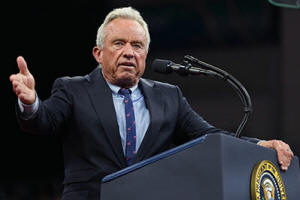
Health and Human Services Secretary Robert F. Kennedy Jr. speaks at
a campaign rally with President Donald Trump at Alico Arena on the
campus of Florida Gulf Coast University, Friday, Oct. 23, 2026, in
Fort Myers, Fla. (AP Photo/Mark Schiefelbein)
 The policy published Wednesday is a
step back from HHS' original plan, according to two of the people
who discussed its development.
HHS officials initially wanted the FDA to draft an official
regulation that would add BPC-157 and other peptides to a list of
drug substances deemed safe for use by compounding pharmacies,
specialty businesses that make customized medications.
FDA officials warned that the agency's scientific
staffers had major safety concerns and would not support a
regulation deeming the peptides safe. HHS officials moved to a
different approach that directs the FDA not to enforce its rules
against pharmacies that compound the substances.
FDA staffers ultimately provided technical assistance in drafting
the HHS plan, including guardrails intended to improve safety, such
as requiring pharmacies to use peptide ingredients from
FDA-registered factories. Additionally, compounders are directed to
collect information on side effects for safety analysis and verify
the purity of peptides they use.
Lurie pointed out that the FDA, under federal law, does not have the
authority to enforce those pharmacy requirements.
The Alliance for Pharmacy Compounding, which represents specialty
pharmacies, said several details need to be clarified — including
when the policy takes effect and how it will intersect with state
pharmacy boards, who traditionally regulate pharmacists.
Decisions over compounding have long rested with the FDA, not HHS
Decisions about regulating peptides and compounding pharmacies have
almost always come from the FDA, which has an office dedicated to
protecting U.S. consumers from unsafe or poor-quality compounded
drugs.
The issue of compounding safety became a greater focus for the FDA
after a deadly outbreak of fungal meningitis in 2012 was linked to
contaminated injections from a Massachusetts compounding pharmacy.
Once a niche business, compounding has grown into a
multibillion-dollar industry, providing customized medications to
doctors, clinics and hospitals.

It’s extremely rare for HHS to take the lead in drafting policies
over the compounding industry, former FDA officials said. But
federal law technically gives HHS authority over drug regulations,
which are then delegated to the FDA.
FDA has warned Americans about safety risks of unproven peptides
Many in the U.S. who are using peptides today do not deal with a
doctor or a pharmacy to get the injections, but often order vials
online sold by chemical manufacturers based in China. Peptide
sellers often try to skirt U.S. regulations by labeling their
products as “for research use only” because the FDA does not
regulate research chemicals.
In 2023, the FDA added more than a dozen peptides, including BPC-157
and TB-500, to its list of substances that should not be compounded
due to risks of allergic reactions, kidney damage and tumor growth.

At a meeting in July, FDA staffers reiterated that more than half a
dozen peptides brought forward for reconsideration remained unproven
in terms of safety and effectiveness.
But a panel of outside experts voted to drop restrictions on the six
peptides named in Wednesday's document. The panel — selected by
Kennedy’s HHS — included several doctors, pharmacists and
consultants who work in the peptide field.
All contents © copyright 2026 Associated Press. All rights reserved |