Judge orders 30-year prison sentence for key figure in Minnesota food
fraud
[October 29, 2026]
MINNEAPOLIS (AP) — A man who played a major role in
defrauding a federal food program in Minnesota was sentenced Wednesday
to 30 years in prison, the latest punishment in a sprawling scheme to
collect millions of dollars during the COVID-19 pandemic by claiming to
have fed needy children.
The depth of fraud in Minnesota — dozens of people have been convicted —
has repeatedly drawn the attention of President Donald Trump, who
ridiculed the Democratic governor for failing to stop it and partly
cited it as grounds for an extraordinary immigration crackdown in the
state's largest cities.
Salim Said operated Safari Restaurant in Minneapolis, which specialized
in dishes from Somalia. He was accused of vastly overstating the number
of meals when seeking payment for providing food. The government said he
was responsible for $44 million in fraud, some of which was committed by
others he recruited.
“You took more than taxpayers' dollars to enrich yourself. You took the
reputation of our state down with you,” U.S. District Judge Nancy Brasel
said.
Said was claiming a “ridiculous daily distribution of 6,000 meals” while
FBI cameras showed 40 people a day collecting food, prosecutors said in
a court filing.
“The defendant and his sites did not serve thousands of children; he
served a calculated, lucrative lie,” prosecutors said.
Said, a native of Somalia, denied the allegations while testifying at
the trial in 2025, saying many meals were delivered off site. But at his
sentencing Wednesday, he changed course and expressed remorse. Defense
attorney Barry Zone, who had asked for a 12-year prison sentence,
disputed that Said was the “architect” as the government alleged.

[to top of second column]
|
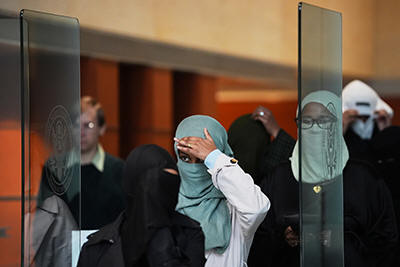
Supporters of Salim Said, who was found guilty in the Feeding Our
Future fraud scheme, leave after Said's sentencing hearing,
Wednesday, Oct. 28, 2026, in Minneapolis. (AP Photo/Ellen Schmidt)

COVID-19 brought changes to a federal program that typically fed
children through schools. Restaurants could participate, and food
distribution was extended to places outside schools.
“For 21 consecutive months, Said made thousands of fraudulent
reimbursement claims, day after day, month after month,” prosecutors
said. “Each submission represented meals purportedly provided to
underprivileged children, yet the listed children themselves were
entirely fictitious.”
The government said Said hit the jackpot: He bought a $1.2 million
home, commercial real estate and an $87,000 pickup truck.
Said was convicted of a raft of charges in 2025, along with Aimee
Bock, the leader of a Minnesota nonprofit, Feeding Our Future. She
is serving a 42-year prison sentence for devising the overall plan
to recruit Said and others to join the federal food program during
the pandemic. A judge ordered her to repay $242 million.
State auditors found that the Minnesota Department of Education
received numerous complaints about Feeding Our Future, but often
told the group to police itself. In January, Gov. Tim Walz said he
would not run for reelection after being pounded by Trump about
theft in programs that rely on federal cash.
All contents © copyright 2026 Associated Press. All rights reserved |