As a historic measles outbreak hits Pennsylvania Amish country, more
show openness to vaccines
[October 30, 2026]
By PETER SMITH and LAURA UNGAR
EPHRATA, Pa. (AP) — Amish and Mennonite shoppers in conservative dress
mingled with shoppers from the wider public on a recent Friday at a vast
outdoor market here, where vendors sold colorful pumpkins and mums, fry
pies and squash, sports jerseys and Barbie accessories.
Such interactions are common in Lancaster County in central
Pennsylvania, home to the largest Amish population in the U.S. — and the
epicenter of the nation’s worst measles outbreak in 35 years. While they
avoid many types of civic engagement for religious reasons, the Amish —
like many other groups vulnerable to measles across the nation — are not
truly separate.
“We are all interconnected,” said Dr. Diego Hijano of St. Jude
Children’s Research Hospital.
Robust vaccination rates once protected Americans much better.
But rates among the general public are now falling, and rates have long
been low among the Amish, creating the perfect conditions for the
contagious virus — officially considered “eliminated” from the U.S.
since 2000 — to spread here and beyond.
Pennsylvania has the most U.S. cases, with over 1,350 this year, more
than a third in Lancaster County alone, according to state figures.
That’s a big undercount, community leaders say, since many people with
measles never see a doctor.
The state has recorded three measles-associated deaths in Lancaster and
two in other counties.
In Amish country, a measles surge poses questions about vaccine
acceptance
The outbreak has especially hit the “Plain communities” of Amish and
conservative Mennonites — so named for their modest dress and limited
use of technology. Vaccination rates, and attitudes about vaccines,
range widely. But overall, they are less likely to be vaccinated than
the general population, due more to culture and habit than doctrine.
Many are now showing a new openness to vaccines, while members of the
general public are also taking extra precautions.
All of this has underscored the interconnectedness of Plain and wider
“English” populations.
The Plain People avoid such areas of civic participation as holding
public office. Still, they regularly shop and do business with their
neighbors in this growing county of half a million people, where an
urban core is ringed by suburban subdivisions abutting Amish farms.
“There’s no way to imagine that this is going to be an isolated
community,” said Dr. Anne-Marie Derrico, chief medical officer at the
nonprofit Union Community Care. It has clinics in the city of Lancaster
and outlying towns, along with a mobile unit operating a “Plain Healthy”
outreach to the Amish and to Mennonites.
“We have Plain patients coming to the city, we have patients in the city
who don’t vaccinate, who are going to school, going to other programs
with other children,” Derrico said.
Pennsylvania's measles rates have declined from their September peak,
but some doctors expect them to rise as winter brings more indoor
gatherings.
While most cases are mild, measles can cause serious and even fatal
complications, such as pneumonia and encephalitis.
Union has held small-scale vaccine clinics to reach Plain populations,
resulting in about 450 measles shots. “That’s hopefully made a
significant impact,” Derrico said.
Union’s clinics are also offering vaccinations for infants earlier than
normally scheduled, as health experts advise in areas experiencing
measles outbreaks.
Lauren and Mason Spence brought their 10-month-old son, Bowen, to a
clinic recently to get his first dose of the MMR vaccine, short for
measles, mumps and rubella. The “English” family frequently goes to
public places, including farmers markets.
“It’s scary,” Lauren Spence said. “It’s spreading quick.”

Vaccine views vary among Plain people
Attitudes toward vaccines in Plain communities have alternately warmed
and cooled over time — most recently cooling in reaction to strict
COVID-19 public health measures, according to community leaders and
scholars. The measles outbreak is prompting many to accept the shots
while reinforcing vaccine skepticism in others.
One Amish farmer, Ephraim Zook, still opposes vaccines even after he and
his wife nursed their young twins through the illness. “We just felt
that measles is a natural thing,” he said.
A Mennonite market vendor said his largely vaccinated community has had
no infections.
One Plain farmer said he got vaccinated after his adult siblings began
getting measles. With vegetables to harvest and tobacco leaves to pick,
“I thought, if I get it, I’m going to be done,” he said.
Most interviewed by the AP asked not to use their names, in keeping with
Plain traditions of not calling attention to themselves.
Those who avoid vaccines usually aren’t driven by ideology, community
leaders and experts say.
“The overwhelming reason had nothing to do with being against
vaccinations,” said Allen Hoover, an Old Order Mennonite and former
administrator of the Parochial Medical Center in the town of New
Holland. “It was simply, ‘Well, we never did before, and we came through
all right.’”
Hoover said the most effective strategy for medical workers is to
encourage vaccination — not to push it aggressively.
It takes time for outside professionals to build trust in Plain
communities, he said.

[to top of second column]
|
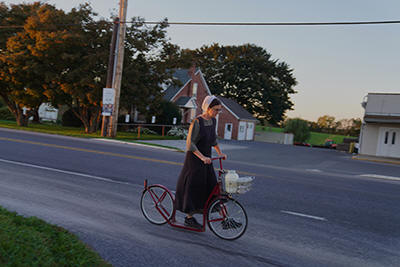
A woman from the Plain community rides a scooter in Intercourse,
Pa., on Thursday, Oct. 8, 2026. (AP Photo/Jessie Wardarski)

About how long?
“Twenty years,” he said.
One cluster of Amish schools and individuals in New York is asking the
U.S. Supreme Court to require their state to allow exemptions to school
vaccine requirements on religious grounds, as Pennsylvania and most
states do.
But the wider Amish leadership hasn't presented this as a religious
issue, according to Steve Nolt, director of the Young Center for
Anabaptist and Pietist Studies at Elizabethtown College in Lancaster
County.
“There’s nothing in Amish theology or historic documents that you can
find that specifically addresses or is opposed to immunization,” he
said.
About 45,000 Amish and 6,000 Old Order Mennonites live in and around
Lancaster County, according to the Young Center. Many rely on
traditional remedies and visit doctors infrequently, Nolt said.
This year's outbreak follows ones in 2025 in Mennonite communities in
Texas and elsewhere across North America.
Contagious virus is a rising threat to everyone
Measles spreads easily when people who have it breathe, cough or sneeze,
or through contaminated surfaces.
“Measles is really the lion king of infectious diseases when it comes to
transmission,” said Michael Osterholm, who directs the University of
Minnesota’s Center for Infectious Disease Research and Policy. “No one
in the United States of America who is susceptible to the measles virus,
either having not been vaccinated or not having previously had it,
should feel safe from measles. No one.”
The risk grows as vaccination rates decline.
According to the Centers for Disease Control and Prevention, 92.4% of
U.S. kindergarteners in 2025-26 received the required MMR shots. That’s
down from 95.2% in 2019-20.
“Though Plain communities are an easy and recognizable target, declining
childhood vaccination rates in our county are not limited to the Amish,”
wrote Berwood Yost, director of the Center for Opinion Research at
Franklin & Marshall College in Lancaster, in a recent commentary.
“Kindergarten vaccination rates have declined in every central
Pennsylvania county since 2020.”

A 2022 survey by the center found the vast majority of Mennonite
families reported having their children vaccinated, compared to about 3
in 10 Amish families.
Yost urged the public not to blame the Amish, or any group, for the
outbreak. “Every one of us is susceptible to misinformation and
confusing messages,” he wrote.
Vaccine hesitancy that rose across populations during the pandemic still
lingers.
That's eroded “herd immunity,” which occurs when enough people in an
area have immunity to measles that it no longer spreads easily. Although
nothing short of 100% immunity guarantees the virus won’t spread, an
outbreak is considered unlikely if a community has a 95% MMR rate.
Pennsylvania’s kindergarten MMR vaccination rate fell to 93.2% last
year.
Lancaster County's rate is 88%, with rates lower in the county’s
religious and other private schools than in public schools, according to
an AP review of state data.
Across the county and state, the percentage of students receiving
religious or philosophical exemptions from at least one required
vaccination has risen significantly.
Nolt said some anti-vaccine groups targeted the Amish with their
messaging.
In 2021, Robert F. Kennedy Jr., who helped lead the anti-vaccine
movement for years, spoke at a Lancaster County fair, alleging the
government was trying to force the Amish to vaccinate.
Now U.S. health secretary, Kennedy recently sparred with Pennsylvania’s
Democratic governor, Josh Shapiro, over the extent of the outbreak.
Further controversy ensued when the county coroner attributed the death
of a measles-infected infant to a ruptured spleen, not the disease
itself.
After a decline in trust, some minds are changing
Lancaster County Commissioner Alice Yoder said public officials should
unite behind the message that the vaccine is safe and effective and
should encourage people to get it.
That approach succeeded during Pennsylvania’s last measles outbreak in
1991.
“There were lines of people in the Plain community that would come and
get vaccinated,” she said.

Dr. D. Holmes Morton, who founded the Central Pennsylvania Clinic in
Mifflin County — which treats Plain patients with genetic diseases —
said the same is happening now.
“We are having more success at having vaccine days,” he said.
Ultimately, this will keep everyone safer, said Hijano of St. Jude.
Getting the shot is “an act of love to your community,” he said. “You
will get protected yourself. But in truth, you are actually protecting
everyone around you.”
___
Associated Press religion coverage receives support through the AP’s
collaboration with The Conversation US, with funding from Lilly
Endowment Inc. The AP is solely responsible for this content.
All contents © copyright 2026 Associated Press. All rights reserved |