Difficult negotiations lie ahead in Israel after Netanyahu's bloc lost
its parliamentary majority
[October 30, 2026]
By CARA ANNA and IBRAHIM HAZBOU
JERUSALEM (AP) — Israel's final election results confirmed Prime
Minister Benjamin Netanyahu’s bloc lost its parliamentary majority and
that weeks of difficult negotiations among very different parties, from
ultra-Orthodox Jewish to secular to Arab-led, lie ahead.
The results released early Friday showed Netanyahu’s bloc won 53 seats
in Tuesday's election. The main opposition bloc won 48. Arab-led parties
secured the other 19, a historic showing. Now parties must meet, bargain
and seek a way to team up for at least 61 seats in the 120-seat Knesset.
Netanyahu, Israel’s longest-serving prime minister, remains in charge.
“Now comes the truly hard part,” centrist politician Yair Lapid said on
X, urging patience and adding: “If you want to know if something’s
happening behind the silence you’re hearing now, the answer is yes.”
The president will task someone with forming a government
Difficult decisions lie ahead. Will the main opposition parties that
campaigned hard to unseat the divisive Netanyahu make the politically
sensitive choice to partner with Arab-led ones? Or will they toss their
vows aside to team up with Netanyahu in a potentially fractious unity
government?
Friday is when much of Israel starts winding down for Shabbat, and it
was not clear who might be meeting with whom. Israelis debated possible
coalitions and challenges, as some expressed traditional wariness around
Arab parties and others insisted it was time for Israel to take a deep
breath and embrace them.

The election results still need to be certified and submitted to the
president next Wednesday. Then President Isaac Herzog will task someone
with forming the new government. That could be the leader of the party
that received the most votes — Netanyahu — or whoever leaders of the
various parties believe is best suited.
If multiple attempts to form a government fail, Israel faces a new
election early next year. Herzog this week said he will do everything in
his power to avoid that scenario.
Netanyahu and Likud target Arab parties without evidence
In the hours before final results were announced, Netanyahu and his
Likud party amplified unsubstantiated allegations that Arab-led parties
had “stolen” the election, potentially with foreign assistance.
The opposition quickly accused Netanyahu of demonizing the Arab
population, which makes up 20% of the population and showed up at the
polls like never before in outrage over Netanyahu’s far-right allies
like National Security Minister Itamar Ben-Gvir. His party lost seats.
In Netanyahu's first public comment Friday, he posted on X asserting it
is forbidden to form a coalition with Arab parties.
The head of Israel’s election committee, Supreme Court Justice Noam
Sohlberg, had said “serious suspicions” of foreign interference had been
brought before him. In a letter to the Shin Bet security agency,
Sohlberg said he could not verify the claims but asked the agency to
investigate.
[to top of second column]
|

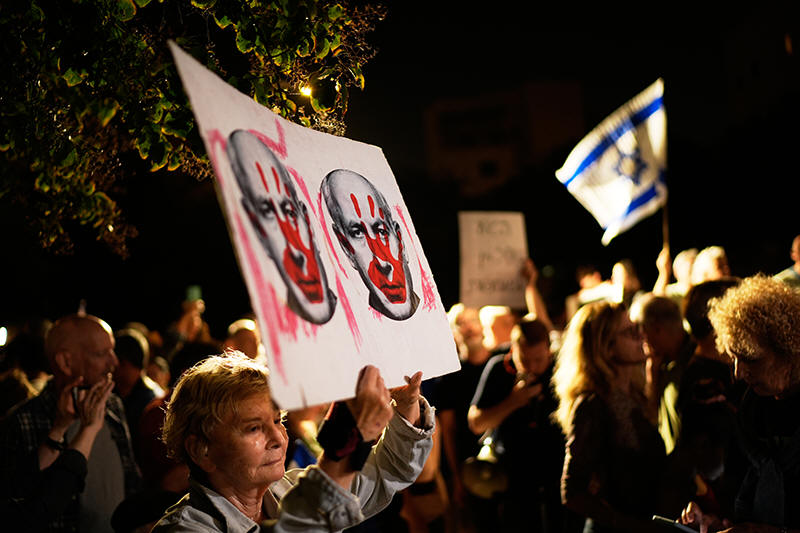
Israeli left-wing activists call for a government with Arab parties
outside Yashar party leader Gadi Eisenkot's residence in Herzliya,
Israel, Thursday, Oct. 29, 2026. (AP Photo/David Goldman)

Israeli media reported that members of Netanyahu’s party were
accusing Qatar of involvement — a country that many Israelis view as
a patron of Hamas, the Gaza-based militant group. Qatar issued a
denial, calling the allegations “ridiculous and dangerous.”
As it announced results, the election commission said the
investigation was based on classified intelligence. Acting Director
General Dean Livne did not elaborate but warned that reports about
the investigation had been “entirely unfounded.”
“It does not affect the final results that will be submitted to the
president, nor does it concern any particular sector of the
population,” he said.
By casting doubt on the vote, Netanyahu appeared to be trying to
block any potential alliance between his opponents and the Arab-led
parties. Netanyahu has suggested that it would be treasonous for
chief rival Gadi Eisenkot or others to join with them.
The Shin Bet, seeking to calm tensions, said its investigation was
not meant to “cast aspersions” on an entire section of the
population that “exercised its right to vote in a democratic and
lawful manner.”
The elections committee also sounded a note of caution in a letter
written to a concerned member of parliament, saying that
“allegations of systematic violations of electoral integrity are
baseless.”
The committee wants findings from the Shin Bet within a week.
Opposition could assert control in the upcoming Knesset
Even as coalition negotiations begin, the new Knesset is expected to
be sworn in Nov. 10. Once it convenes, Eisenkot’s bloc could join
forces with the Arab parties to elect a new Knesset speaker, giving
them control over the parliamentary agenda and potentially allowing
them to advance and pass legislation before a new government is
formed.
Already, hundreds of Israelis have been holding rallies urging
Eisenkot and others to join forces with the Arab-led parties, a step
that has happened only once before, briefly, in 2021.

“We are here today, calling for change, for Arab-Jewish partnership.
The Arabs of the land of Israel are not dangerous to security. They
contribute to the society,” said Danny Elgarat, brother of late
hostage Itzik Elgarat, at a rally outside Eisenkot’s home.
If Netanyahu loses office, that would set off a cascade of events
that critics say he has desperately sought to avoid. He would be
taken to account over yearslong corruption allegations, and an
inquiry almost certainly would begin into security failures before
the devastating Hamas-led Oct. 7, 2023, attack.
All contents © copyright 2026 Associated Press. All rights reserved |