Vote Republican, or else: How Trump is dangling government help on the
campaign trail
[October 30, 2026]
By SEUNG MIN KIM
WASHINGTON (AP) — President Donald Trump says Georgia GOP Senate
candidate Mike Collins can call him whenever he wants to ask for help
for his state. But if Georgia reelects Democratic Sen. Jon Ossoff, Trump
says it could be another story.
“There’s a big difference between that and Pee-wee Herman calling,”
Trump said last week in Perry, Georgia, using his derisive nickname for
Ossoff. The president acted out a hypothetical scenario at his rally
where Ossoff called to ask for money for his state, with Trump
responding, “I don’t give a damn what he wants.”
It’s been a recurring theme at Trump’s rallies this month: From North
Carolina to Ohio to Kansas, the president has dangled the idea that his
administration would be far less likely to help states where Democrats
win in the upcoming midterm elections.
Trump has sandwiched the threats into rallies where he has announced
goodies like new semiconductor investments, a submarine repair center
and fewer limits on a certain type of diesel, underscoring to the
audience the types of tangibles an all-Republican Washington could
continue to deliver for voters should his party remain in power after
November.
But the president’s utterances — part of a larger political strategy
that’s anchored on making the midterms about himself and activating
conservative voters — have also injected politics into processes that
have traditionally remained apolitical, such as doling out disaster aid
and providing benefits for veterans.
“It’s a losing strategy for the failed president to insult and threaten
voters while he’s in town reminding them he made everything more
expensive,” Ossoff told The Associated Press in response to Trump’s
rally comments in Perry.

Asked for further elaboration on the pattern of remarks, the White House
said Trump is committed to keeping a Republican majority in Congress so
“he can continue to deliver on his winning, commonsense agenda.”
White House spokesman Davis Ingle cited Trump’s policies on taxes,
prescription drugs, immigration and other policies and added, “Democrats
have made it clear that they have no agenda to improve the lives of the
American people.”
A threat in North Carolina shows how the strategy can backfire
Yet some of Trump’s remarks have handed ammunition to Democratic
candidates in key battleground races.
A sweeping 2022 veterans law signed by then-President Joe Biden allowed
those facing health conditions linked to contaminated water at Camp
Lejeune, a Marine Corps base in North Carolina, to file for
compensation.
In Greenville, North Carolina, earlier this month, Trump announced that
$1 billion in cash settlements had been delivered to veterans and their
family members who had been affected by the Lejeune contamination, and
that he would direct the Justice Department to settle all remaining
legitimate claims expeditiously — “if we win the House and the Senate.”
“So, if we don’t win, there’s no money,” Trump said. “If we do win,
you’re getting it.”
Questioned afterward at the White House, Trump said, “If we’re not
there, then somebody else is going to have to settle” the Camp Lejeune
claims and he “can’t speak for another administration,” although his own
Justice Department is handling the claims.
It wasn’t the first time Trump had made that type of remark in North
Carolina, where his handpicked Senate candidate, Michael Whatley, has
struggled to gain traction against Democrat Roy Cooper, a well-known
former governor.
During a September rally in Gastonia, Trump said North Carolina was
still waiting on more Hurricane Helene recovery money and added, “Now,
if Michael loses, I’m not sending it,” even though he immediately said
he was kidding.
Cooper has described Trump’s Camp Lejeune threats as “insulting and
frustrating” while his campaign has gone after Whatley for refusing to
denounce them. (Whatley, asked in a local television interview about the
president's comments, said caring for the affected veterans and families
is a priority.)

[to top of second column]
|
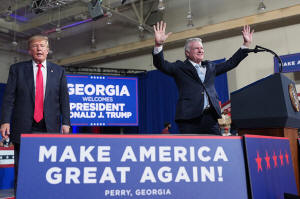
President Donald Trump listens as Georgia U.S. Senate candidate Rep.
Mike Collins, R-Ga., speaks at a campaign rally at Guardian Centers
of Georgia, Saturday, Oct. 24, 2026, in Perry, Ga. (AP Photo/Mark
Schiefelbein)

The threat angered Jill Steen Dilgard, whose father and other
relatives served at Camp Lejeune and were subsequently diagnosed
with cancer and other health issues. She said in an interview with
the AP that it was “totally unacceptable” for the president to
condition care for those who had served in the U.S. military on the
results of the midterms.
“It made me physically sick, and it infuriated me,” said Steen
Dilgard, who helps advocate for other Camp Lejeune victims and their
families. “You're playing politics and trying to bribe for a vote.
So many hundreds of thousands have already lost their lives, and
hundreds of thousands are suffering, and many have been given a
death sentence.”
In Kansas, Trump said an ethanol decision hung in the balance
Trump has frequently announced state-specific perks at rallies, from
protecting a steam-powered heat utility in Ohio to investing
billions in Montana mortgages through Fannie Mae and Freddie Mac to
pardoning truckers in Alaska who had pleaded guilty to violating
federal environmental laws.
But sometimes, he takes it a step further.
During a trip to Kansas to shore up GOP Sen. Roger Marshall, Trump
noted to the crowd that he had granted a waiver that would
temporarily allow year-round sales of E15, an ethanol-blended gas
that is usually restricted during the summer.
“With Roger Marshall in the Senate, we will make year-round E15
permanent,” Trump said during a rally in Park City. “But if Adam
Hamilton is in, I’m not doing it. That’s it. I’m only doing it for
him.”
Although there is legislation in Congress that would allow for
permanent year-round sales of E15, it can also be done at an
administration’s discretion through temporary waivers issued by the
Environmental Protection Agency.
In response, Hamilton's campaign did not criticize Trump directly
but said, “Kansans are tired of our broken politics that treats
public service like it’s all about opposing teams."
“Roger Marshall has been in Congress for 10 years and never passed
year-round E15,” said Tyson Brody, a spokesman for the campaign.
"When Adam is senator, he will look forward to working with anyone —
including President Trump — to finally deliver on this and other
important priorities for Kansas.”

Trump says he's more apt to help people he likes
Other times, the president’s threats to not help Democratic-led
states have seemed less about policy and more about personal
relationships.
In Vandalia, Ohio, this month, Trump again was noting how Republican
officeholders in the state were pushing him on disaster relief and
added that “when you are president, you have a lot of power over
states.”
If Democratic gubernatorial candidate “Amy Acton got in, I don’t
know anything about her,” Trump continued. “She’s never gonna call
me. I’m never probably gonna work the same way. You just can’t. It’s
just human nature. But I’m not gonna help her probably.”
Acton campaign spokesperson Addie Bullock said in response that the
candidate is “committed to working with anyone, Democrat or
Republican, to make life better for working Ohioans.”
At the Perry, Georgia, rally, Trump made clear he wasn’t joking
about his threat to ignore requests from Ossoff.
“People don’t realize what a big difference it makes. And probably I
shouldn’t say that because they’ll say, ‘This is not appropriate,’”
Trump said, explaining that “having people that you like call you as
opposed to people that you can’t stand” makes a big difference.
All contents © copyright 2026 Associated Press. All rights reserved |