Michigan school districts offer insurance-free care to beat rising
health costs
[September 01, 2026]
By ROBIN ERB/Bridge Michigan
Three Michigan school districts are betting that a specialized clinic
may be the antidote to surging health care costs.
The medical care here at the Corunna Plum Health clinic — inside a
collection of converted high school classrooms on the district’s main
campus — is free.
The 13 patients scheduled on a recent day handed over no copays and no
deductibles for physician assistant Shelley Littleton to tend to a range
of maladies — from poison ivy to pink eye and from high blood pressure
and high anxiety.
They also left with nearly $550 worth of medications — also free.
What’s more, each had a visit scheduled for at least a half-hour long.
“What I love about it more than anything else is the ability to be seen
and have a lengthy conversation,” said John Fattal, superintendent of
Corunna Public Schools, northwest of Lansing.
“This is health care the way it’s supposed to be,” he said.
Corunna and two neighboring school districts — Lansing and Van Buren,
are part of a consortium that offers health care through Plum Health, a
Detroit-based provider of “direct primary care.”
It’s a growing category of health services that bypass traditional
insurance in favor of a direct financial transaction between the patient
— or in this case the patient’s employer — and the health provider.
Just more than two years ago, Corunna began paying $90 each month for
each of its 255 employees to use a two-day-a-week primary care clinic,
established to serve its employees and their families.

The districts are charged for deeply discounted medications provided by
the clinic — meaning patients have no out-of-pocket prescription drug
costs.
It’s a gamble.
The districts expect this type of easy-access, free primary care will
help employees and their families reduce trips to the emergency rooms,
where costs can easily top $1,000, or urgent care visits that cost
hundreds of dollars.
About 110 of the district’s staff carry insurance through the Michigan
Education Special Services Association. Like most conventional benefit
packages, it covers emergency and urgent care and hospitalization.
But how many ER visits could be avoided, Fattal reasons, if parents knew
they could see their doctor first thing in the morning?
One family with strep throat running through it makes a
middle-of-the-night ER run, costing the districts’ insurance pool
hundreds, if not thousands, of dollars, That cost of that single virus —
the ER care, the lab draws and the medications — can trounce more in a
single night than a year’s worth of direct primary care fees.
Those crises, repeated throughout the year among hundreds of employees
and their families, in turn, drive up the school’s overall health care
expenses year after year.
District employees who don’t have that insurance, such as part-time food
service workers or paraprofessionals, may have insurance through
spouses, from the individual market, or none at all, Fattal said.
But the cost to see Littleton is the same, no matter their insurance
status.
No insurance? No problem.
In its most basic form, direct primary care works outside of insurance.
It’s an alluring possibility as insurance grows increasingly out of
reach. Nearly 131,000 Michiganders dropped insurance on the federal
marketplace this year, and more than 80,000 beneficiaries have
disappeared from the state’s safety net since January as Medicaid
continues to shrink, according to the latest state data.
The pressure is on, too, for Michigan business and for workers with
job-related health coverage.
Health care costs for the nation’s employers are expected to approach
double-digit increases next year, according to projections this month by
Chicago-based insurance broker Aon. On average, employer costs will rise
9.5% — to more than $19,000 per employee, next year — driven in large
part by high-priced drugs and increased use of the medical system, Aon
estimates.

On average, workers’ health care costs will jump nearly 8% on average,
to $5,297, the broker projected.
Direct primary care doctors say they sidestep those budget-bulging
surges, as well as the paperwork complications associated with
insurance.
In doing so, they can deliver more personal, more complete care, said
Dr. Philip Eskew, a direct primary care physician based in South
Carolina.
“You get to spend time with the patient rather than screaming into your
medical record to make it happy so that you can bill whatever code you
need to bill,” he said.
Eskew’s website, dpcfrontier.com, maps direct primary care providers.
There’s no way to know precisely how many direct primary care doctors
there are, since most of them work outside of insurance — a metric for
much of the nation’s health care research.
But the numbers are certainly increasing, Eskew said.
Without extra administrative personnel to handle insurance billing,
clinics can keep their costs down, too, said Eskew.
At the Detroit and Royal Oak Plum Health sites, patients pay $95 a month
to have round-the-clock access to family medicine care.
The monthly fee gives patients access to the clinics — often the same
day they call. In contrast, doctors in their insurer’s network might not
have an appointment opening for more than a week, said Dr. Paul Thomas,
founder of Plum Health.
That’s because the nation’s primary care doctors often are said to have
about 2,500 patients on average — a number that some have argued is
unrealistically high. In comparison, direct primary care doctors serve
just more than 400 patients, according to a 2024 survey of direct
primary care doctors by the American Academy of Family Physicians.
[to top of second column]
|
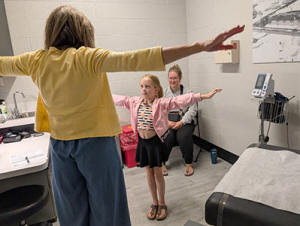
Physician assistant Shelley Littleton, left, conducts a sports
physical for Leigha Eisler, 8, as Eisler's mother watches, at the
Corunna Direct Primary Care clinic in Corunna, Mich., Aug. 19, 2026.
(Robin Erb/Bridge Michigan via AP)
 At Corunna recently, each of the
day’s appointments was scheduled for at least a half hour. Two new
patients were scheduled for 60 minutes.
One patient had called at 8 a.m. that day, scheduled the appointment
for an hour later. By 9:27, he was on his way out of the clinic and
onto work, medication in hand.
In a state short of educators, the districts now can offer
easier-access, no-cost medical care to their employees. In the case
of Corunna, the clinic is located on the school district’s main
campus.
“We see this as a recruitment and retention tool,” Fattal said.
Erika Eiseler had stopped by with her daughter, Leigha, 8, for a
school physical. The office manager at Corunna’s Elsa Meyer
Elementary School and her family are insured by Eiseler’s husband, a
manager of an HVAC company.
Here, their access is convenient, not rushed, and free from the $40
copay for a doctor’s visit through the family’s insurance policy,
Eiseler said, as Leigha read the letters from an eye chart on the
wall.
Eiseler figures the family had at least eight doctors’ appointments
last year for the normal seasonal illness that so many families
face. “And then there were medications about half the time, so …
what? Eight times last year? So you have eight times $40, plus the
medicine?” Eiseler said.
Plum buys medications in bulk, charging the schools a 15% markup
that’s charged to the school, Thomas said.
Even then, “we’re talking pennies a pill,” Thomas said, from his
Detroit office.
The care in these cement block rooms, where a decades-old classroom
pencil sharpener still hangs on the walk, costs the family nothing,
Eisler said.
“We’re literally putting money back into their pockets,” Fattal said
of the district’s employees.
The math doesn’t work
Littleton, the physician assistant who sees patients at the Corunna
clinic, doesn’t have regular health coverage herself, although she
carries a rider policy to cover “catastrophic” health care costs if
necessary.
She did the math, she said. It didn’t add up.

A mammogram each year? Free at certain clinics.
Her OB-GYN appointment each year? $300.
Colonoscopy every third year? $2,000 or so.
At 56 years old, she’d pay $650 a month for insurance, she said.
Worse, the $10,000 out-of-pocket max meant she’d probably never see
any real benefit from it.
Littleton says she represents “middle-of-the-road” Michiganders —
not poor enough to qualify for free health care, but also not
wealthy enough to afford it.
“I really understand the insurance runaround because I am the poster
child,” she said.
Helping or hurting the larger picture?
The American Academy of Family Physicians and American Medical
Association and other medical groups support the ability of
physicians to work in direct primary care. Some have argued that
expanding direct primary care could expand access in underserved
areas.
Earlier this year, the Michigan State Medical Society, which
represents doctors of a range of medical specialties, called on the
state to build up its primary care network — a “cornerstone” of the
larger health care delivery system, it said.
Nearly 1 in 3 Michigan residents lack primary care access, while the
state directs about 5% of total health care dollars to primary care,
even though experts say 12–15% is necessary for a robust primary
care system, according to the report.
Still, there are arguably downsides to increased use of direct
primary care: Those physicians take on much smaller patient loads,
arguably stretching the number of primary care providers in the
state even thinner. In other words, with each doctor that moves to
direct primary care, he or she sheds hundreds of patients who then
are left to find another doctor.
Plum Health founder Thomas — whose time offering street medicine
grounded his belief in more affordable health care — looks at it
this way: With few patients and a better work-life balance, today’s
primary care doctors won’t burn out early and tomorrow’s doctors
will choose primary care as their specialty.
It’s a shift that would take years, but also would transform
medicine in a way that saves both costs and lives, Thomas said.
And more immediately? “It’s working out for insured people because
they don’t get dinged with (cost-sharing for) those ER and the
urgent care visits,” Thomas said.
And for the uninsured, he said, “they have something where they had
nothing before.”
All contents © copyright 2026 Associated Press. All rights reserved
 |