Asian shares are mixed as Brent crude approaches $100 a barrel
[September 09, 2026] By
YURI KAGEYAMA
TOKYO (AP) — Asian shares were mixed in cautious trading Wednesday as
investors watched for what might happen on interest rates and the war
with Iran pushed oil prices higher.
Japan's benchmark Nikkei 225 lost 0.2% to 65,142.78, while South Korea's
Kospi gained 1.4% to 7,051.64.
In Hong Kong, the Hang Seng dipped 0.3% to 25,244.15. The Shanghai
Composite gained 0.4% to 3,956.08.
Australia's S&P/ASX 200 slipped 0.1% to 8,911.40.
Taiwan's Taiex edged 0.2% higher and the Sensex in Mumbai shed 0.8%.
On Tuesday, U.S. stocks fell as markets reopened after a three-day
weekend, with the S&P 500 sinking 0.6%. The Dow Jones Industrial Average
dropped 1.2%, and the Nasdaq composite dipped 0.3%.
Markets are feeling the pressure from rising oil prices. Brent crude,
the international standard, surged 1.6% to $99.48.
Benchmark U.S. crude rose 1.4% to $94.35 a barrel.
Increased fighting in the Middle East is constricting the global flow of
oil and more costly oil has worsened worries over high inflation.

A closely watched report on U.S. inflation comes on Friday. That update
will show how much more people were paying in August for groceries,
clothes and other costs of living than a year earlier.
Economists expect it eased a bit to 3.3% from July’s 3.4% inflation
rate. That remains well above the 2% target that the Federal Reserve has
set as its goal.
[to top of second column] |
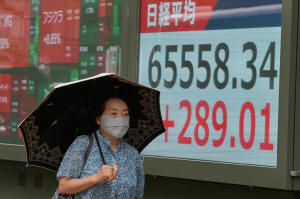
A person walks in front of an electronic stock board showing Japan's
Nikkei index at a securities firm Wednesday, Sept. 9, 2026, in
Tokyo. (AP Photo/Eugene Hoshiko)
 In the bond market, the yield on the
10-year Treasury rose to 4.79% from 4.78%. It is near its highest
level since the autumn of 2023.
The Fed meets next week to decide whether to cut, raise or hold
interest rates steady. The traditional move for the Fed when
inflation is high is to raise its main interest rate. But President
Donald Trump has been lobbying for lower interest rates.
Japan's central bank also will meet next week to decide on its
benchmark rate. Market watchers are expecting an increase, with the
question shifting to by how much and if there will be more rate
hikes this year.
The U.S. Treasury secretary has made public remarks widely seen as
critical of Japanese government policies that tend to favor a weak
yen.
“Treasury Secretary Scott Bessent delivered an unusually forceful
message to yen bears, declaring that traders could ‘bet against’ him
following the joint U.S.-Japan yen intervention on 31 July,” Ng Jing
Wen, an analyst at Mizuho Bank, said in a commentary.
In currency trading early Wednesday, the U.S. dollar fell to 153.33
Japanese yen from 153.99. The euro cost $1.1641, inching up from
$1.1624.
All contents © copyright 2026 Associated Press. All rights reserved |