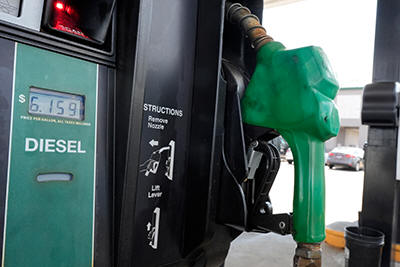
US diesel prices soar past $6 a gallon, deepening strain for hauling
everyday goods
[September 11, 2026] By
WYATTE GRANTHAM-PHILIPS
CHICAGO (AP) — Diesel prices in the U.S. hit yet another record on
Friday, soaring past $6 a gallon on average as Washington’s war with
Iran disrupts the world’s flow of fuel.
The national average of $6.05 is up from $5.85 last week and $3.70 this
time last year, according to motor club AAA.
Higher diesel prices mean more expensive transportation for a long list
of everyday goods. That’s because diesel is used for many freight and
delivery networks. And some businesses have already passed along steeper
costs to consumers in the form of added fees on online orders and
packages in the mail.
Shoppers may feel more and more sticker shock, particularly in the
grocery aisle. Perishable foods, like meat and produce, face one of the
most immediate strains of expensive diesel because they need to be
hauled in and restocked frequently — or may be harvested using farm
equipment powered by the fuel.
It can take time for those costs to trickle down. But the surge in
diesel prices doesn’t appear to be going away anytime soon.
Prices at the pump for diesel and regular gasoline — which hit $4.29 on
average in the U.S. Friday — closely follow that of crude oil. And oil
has renewed its rise recently. This week, both Brent, the international
standard, and U.S. crude surpassed $100 a barrel for the first time in
months as fighting between the U.S. and Iran escalated again.
Political ramifications may pile up in the meantime. President Donald
Trump, who has repeatedly tried to downplay the effects of the Iran war,
said that oil prices likely won’t come down until after November’s
midterm elections.

What’s driving the latest jump for diesel
American diesel prices are now significantly higher than they were
before the U.S. and Israel launched their war against Iran in late
February, when the national average sat at about $3.76 per gallon per
AAA. Prices quickly climbed as the cost of crude oil — the main
ingredient in refined fuel like diesel, as well as gasoline — soared
amid supply chain disruptions across the Middle East, notably with most
tanker traffic bottlenecked in the key Strait of Hormuz.
Despite prices cooling some during hopes for peace earlier in the
summer, oil has now renewed its climb as fighting once more escalates.
Brent crude, the international standard, was trading at more than $105 a
barrel Friday, up from roughly $70 before the war.
When adjusted for inflation, however, prices have been higher in the
past. Ahead of the 2008 financial crisis, for example, diesel hit about
$4.74 a gallon, equivalent to $7.20 in 2026, according to the
government’s latest data. And 2022’s then-record of nearly $5.82 —
reached just months after Russia invaded Ukraine — would be about $6.56
this year when accounting for inflation.
That doesn’t take the pain away from today’s steep prices, which are
already bringing ripple effects for the economy and wider costs of
living. Drivers are feeling the pain with gasoline, too.
Friday’s average $4.29 for a gallon of regular unleaded is up from $2.98
before the Iran war, although still below the 2022 peak of nearly $5.02
a gallon nationwide.
Diesel has been more expensive than gasoline in the U.S. for decades,
and its price has risen at a faster pace before. Some reasons include
less flexibility in demand and diesel’s position in global commerce
overall. Individual households may find ways to drive less when gas
prices are high, for example, but there’s fewer immediate substitutes
for networks that rely on diesel to haul goods worldwide.
All eyes on food
Diesel is integral to every part of the food supply chain. It powers
farm equipment and fishing boats, as well as the trains and trucks
headed to grocery stores.
Fuel accounts for roughly 15% to 30% of the total cost of food,
according to the Independent Grocers Alliance, a grouping of 7,500
global supermarkets. So higher diesel costs often result in more
expensive groceries, although it can take a while for energy shocks to
wind their way through the supply chain.
[to top of second column] |
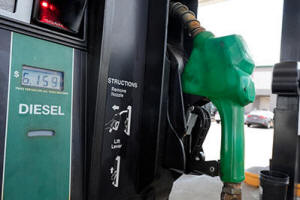
The price for diesel fuel is displayed on a pump at a gas station
Friday, Sept. 4, 2026, in Dickson, Tenn. (AP Photo/George Walker IV,
File)
 Items that need to stay refrigerated
while they’re transported are often the first to see prices rise,
according to David Ortega, a professor of food economics and policy
at Michigan State University. In July, for example, overall U.S.
grocery prices were up 2.7% compared to a year prior, but seafood
prices were up 7% and fresh fruit prices were up 4.9%.
Ortega cautioned other factors can be at play, too. Lettuce also
faced higher transportation costs in July, but a drop in demand due
to the cyclospora outbreak caused prices to fall.
Still, consumers could feel more of a squeeze the longer diesel
prices remain high.
“Early on, much of the cost increase gets absorbed along the supply
chain through existing freight contracts and retailer margins,”
Ortega explained last week. “But as contracts reprice and fuel
surcharges take hold, more of that cost makes its way to the grocery
store.”
Fuel shocks range far and wide
Back in April, e-commerce giant Amazon rolled out a temporary 3.5%
fuel and logistics surcharge on some third-party sellers. United
Parcel Service, FedEx and the United States Postal Service also
moved to add fees on some of the packages they ship earlier in the
war, citing rising costs for fuel overall.
Experts warn that price hikes could mount the longer diesel remains
expensive. A range of other products are also transported by
diesel-powered networks, including clothing, cosmetics and
furniture.
The ramifications extend beyond consumer goods. Some public transit
buses and trains also run on diesel. And diesel generators are often
used for backup or emergency power, if not central electricity
sources in some remote parts of the world.
Experts warn the consequences could continue to deepen, particularly
in African and Asian countries, which rely more on Middle East
imports and have already been hit the hardest by energy shocks.
According to the latest data from Global Petrol Prices, diesel
prices in Nigeria have surged over 90% since late February —
followed by nearly 87% in Indonesia and 80% in Lebanon.

Price tags vary widely between countries, due to factors ranging
from fuel taxes to local economic conditions. As of Monday, diesel
prices in Nigeria were about $4.95 per gallon (1,730 naira per
liter) on average. Meanwhile, the highest sticker price reported by
Global Petrol Prices was in Hong Kong, where diesel costs have
jumped almost 26% during the war and averaged at $17.78 a gallon
(nearly 37 Hong Kong dollars per liter) Monday.
A long road of constrained supply — and perhaps higher and higher
prices — could be ahead.
S&P Global Energy said Thursday it now doesn’t project crude oil
production in the Middle East to return to prewar levels by the end
of 2027.
“The market is not returning to calm, it is adjusting to the new
normal,” said Jim Burkhard, VP and global head of crude oil research
at S&P Global Energy, noting security and logistical challenges
continue to limit oil flows.
___
Associated Press writers Dee-Ann Durbin in Detroit and Mae Anderson
in New York contributed to this report.
All contents © copyright 2026 Associated Press. All rights reserved |