US home sales weaken to slowest pace in more than a year as mortgage
rates, home prices climb
[September 11, 2026] By
ALEX VEIGA
Sales of previously occupied U.S. homes declined in August to their
slowest annual pace in more than a year as home shoppers grappled with
rising mortgage rates and home prices.
Existing home sales fell 2% last month from July to a seasonally
adjusted annual rate of 3.98 million units, the National Association of
Realtors said Thursday. This is the third straight monthly decline.
Sales also fell 1.2% compared with August last year. The latest sales
tally is just shy of the 4 million pace economists were expecting,
according to FactSet.
“It’s not a surprise home sales and mortgage rates move in the opposite
direction and we have seen mortgage rates rising, rising, rising from
February,” said Lawrence Yun, NAR’s chief economist.
Home sales have been mostly hovering close to a 4-million annual pace
going back to 2023, far short of the historic norm that is closer to
5.2-million. The last time the annual sales pace came in below 4 million
was June 2025.
Despite the latest pullback, existing U.S. home sales are running 1.6%
higher through the first eight months of this year than they were in the
same stretch of 2025, NAR said.
The housing market has been stymied in large part by rising borrowing
costs, as mortgage rates have marched higher in the months since the war
between the U.S. and Iran started in late February. Expectations of
higher inflation amid surging oil prices have pushed up the long-term
bond yields that lenders use as a guide to pricing home loans, driving
mortgage rates higher.

The average rate on the benchmark 30-year mortgage hit 6.76% this week,
its highest level in more than 14 months. It briefly dipped below 6%
before the war started.
Yun noted that rate could soon reach 7%, given that mortgage rates tend
to follow moves in the 10-year Treasury yield, which is at levels not
seen since late 2023. The yield was at 4.92% on the bond market as of
Thursday morning.
Even as sales slowed, home prices continued to rise nationally last
month. The U.S. median sales price increased 1.6% in August from a year
earlier to $429,100, an all-time high for the month of August based on
data going back to 1999, NAR said. Home prices have risen on an annual
basis for 38 months in a row.
The U.S. housing market has been in a slump since 2022, when mortgage
rates began to climb from pandemic-era lows. Sales of previously
occupied U.S. homes were essentially flat last year, stuck at a 30-year
low.
Years of soaring home prices, especially in the early part of this
decade when rock-bottom mortgage rates fueled a buying frenzy, have left
many would-be homebuyers frozen out of the market. And a chronic
shortage of homes for sale nationally, due partly to years of
below-average new home construction, has helped prop up home prices even
in a multiyear sales slump.
[to top of second column] |
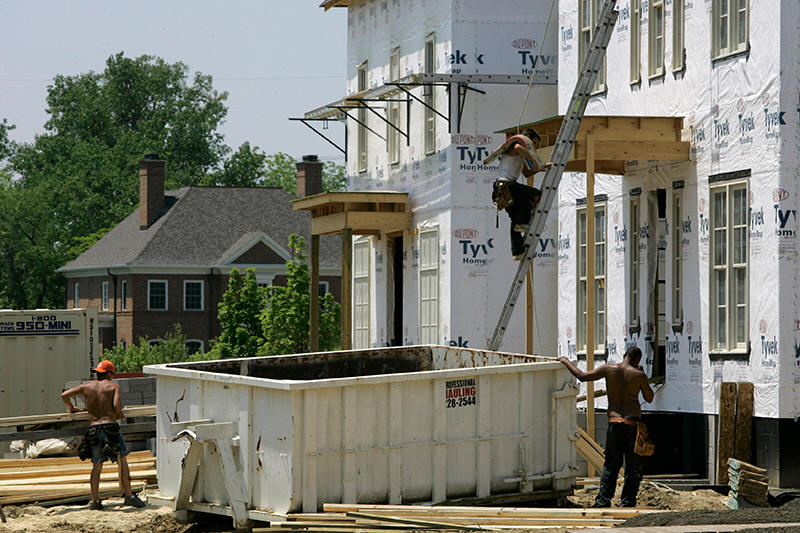
Luxury homes are under construction in a subdivision, May 22, 2007
in New Albany, Ohio. (AP Photo/Kiichiro Sato, File)
 Many of the homes purchased last
month likely went under contract in July and June, when the average
rate on a 30-year mortgage ranged from 6.43% to 6.66%.
Regionally, sales fell last month from July in the Northeast,
Midwest and South. Sales were flat in the West. Prices, meanwhile,
continued to rise in the Northeast faster than the rest of the
country, climbing 4.3% from August last year amid a shortage of
homes on the market relative to other regions.
The sales slowdown is leading to unsold properties sitting on the
market longer, helping boost the number of available homes.
Although home inventory levels remain well below historical norms,
there were 1.62 million unsold homes at the end of last month, up
3.2% from July and up 5.9% from August last year, NAR said. That’s
still short of the roughly 2 million homes for sale that was typical
before the COVID-19 pandemic.
Still, August’s month-end inventory translates to a 4.9-months’
supply at the current sales pace. That’s the highest level in over
10 years. Traditionally, a 4- to 6-month supply is considered a
balanced market between buyers and sellers.
The increase in homes for sale gives home shoppers who can afford to
buy at current mortgage rates or pay all cash a wider selection and
potentially, more leverage in negotiating better sales terms.
In August, the national median home listing price fell 1.2% from a
year earlier, while roughly 20% of listings had their initial price
lowered, according to Realtor.com.
First-time buyers accounted for 30% of home purchases last month, up
from 29% in July and 28% in August last year, NAR said.
Historically, first-time buyers make up closer to 40% of home sales.
Affordability remains a primary concern for home shoppers, as home
prices, mortgage rates, property taxes and insurance costs are now
significantly higher than a few years ago, noted Heather Long, chief
economist at Navy Federal Credit Union.
The trends are also putting pressure on homeowners eager to sell.
“It’s not a good time to sell your home,” Long said. “Americans are
hitting the pause button on homebuying.”
All contents © copyright 2026 Associated Press. All rights reserved
 |