The push to remove lead pipes is on. Thousands of water systems still
don’t know where theirs are
[September 11, 2026]
BY M.K. WILDEMAN
Kathryn Pilgrim knew the century-old Victorian she bought in Dunkirk,
New York, came with old plumbing. She replaced pipes she suspected of
containing lead and later installed a kitchen filter designed to remove
heavy metals.
But six years after buying the house, she still can’t be sure that her
tap water is lead-free because she doesn't know what material was used
for the pipe that runs under her front yard and connects to the city
water supply. Dunkirk is nearly two years behind schedule on an
inventory that would give Pilgrim and other residents that information.
Dunkirk, which supplies water to about 5,000 homes and businesses, is
one of more than 1,300 public water systems cited by the U.S.
Environmental Protection Agency for failing to meet an October 2024
deadline to hand in an inventory of the water lines that could be
leaching the heavy metal into Americans' drinking water, an Associated
Press analysis of the agency’s enforcement data shows.
Roughly 6,300 water systems serving 3.8 million Americans have still not
submitted a required list of how many lead service lines remain in use.
Those inventories are critical for cities to replace all lead pipes by
an upcoming 10-year deadline. Failing to document the lines also means
residents won't know if their homes have a potential source of lead
exposure.
Pilgrim, a special education teacher who has fostered teenagers, had
been educated on the dangers of lead, especially in paint. The colon
cancer survivor's concerns extended to her drinking water.
“I just thought there was some stuff in the water that might not be
great,” she said.

Officials with the city of Dunkirk did not respond to requests for
comment.
Lead pipes are abundant across New York and many communities around the
country with older infrastructure. The city of Buffalo’s data shows 45%
of its service lines — which connect homes and businesses to the water
supply — are made of lead, the third-highest rate of any major city. The
city of Fredonia, which neighbors Dunkirk, reported 28%.
Lead is a priority under Trump administration
Lead is a neurotoxin that can stunt children’s development, lower IQ
scores and increase blood pressure in adults. Roughly 4 million homes
and businesses are still connected to water utilities via lead pipes,
according to the EPA’s latest estimate.
How much lead is entering the building depends on factors like the water
chemistry and the pipe's condition, but lead service lines remain the
most significant source of the heavy metal, according to the EPA.
The EPA has touted its work on lead lines as a key environmental win.
About three-quarters of the drinking water enforcement orders issued by
the EPA since President Donald Trump’s return to office were related to
missing inventories.
Most water systems with missing inventories are small — 84% provide
drinking water to fewer than 500 people, the AP analysis shows. Many are
small housing developments, mobile home parks or schools.
The EPA said it turned to enforcement only after efforts to help water
systems comply were unsuccessful. Utilities need the inventories to
prepare for a 2027 deadline requiring most drinking water providers to
replace their lead lines within 10 years, the agency said. The Trump
administration has also defended that aggressive deadline, enacted under
Biden, in court.
Rob Hayes, a senior director with Environmental Advocates of New York,
said it is a rare environmental regulation the Trump administration has
not sought to scrap.
“It speaks to the universal popularity of getting lead out of drinking
water,” he said.
Inventories are not easy
About 3,500 water systems reported they don’t know what their service
lines are made of. One in five service lines nationwide were reported as
having unknown materials.
[to top of second column]
|
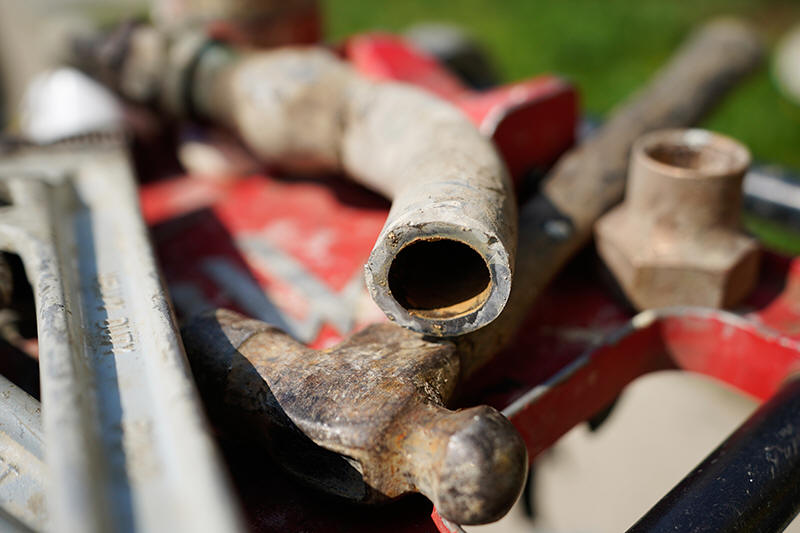
A lead pipe that brought drinking water to homes sits on a
workstation after it was replaced with copper Tuesday, July 21,
2026, in Chicago. (AP Photo/Alyssa Goodman)
 Many utilities are racing to
identify unknown pipes by next year, when they must begin replacing
them.
In Chicago, home to the most lead lines of any city in the country,
crews are working block-by-block, digging up the pipes that branch
off from the utility's main line. The city still doesn't know the
material of close to one in 10 service lines. So in those cases,
crews may have to excavate them to check the material, said Patrick
Schwer, the city's water quality director.
“We are digging through every single piece of information that we
have associated with every single service line trying to find any
indications of the material,” he said. “We’re scouring millions of
work orders, trying to pull at little threads of information.”
Lead pipes for public water date as far back as the late 1800s and
were prevalent all the way to the 1950s. Lead was a preferred
material at the time because it was resistant to corrosion, and as a
result, the original lines remain in use decades later.
Chicago advises residents with unknown lines to assume they are made
of lead if their building predates 1986, when it was banned under
the U.S. Safe Drinking Water Act.
Records of the installations were often lost, incomplete or
illegible. Lapses in recordkeeping have made it difficult for some
utilities to complete their inventories, said Joshua Klainberg,
senior vice president with the New York League of Conservation
Voters.
Still, Klainberg said, leaving residents in the dark about whether
they should take precautions by not submitting an inventory at all
is “unforgivable.” Even an incomplete inventory can alert people
they may have a lead service line, allowing them to take precautions
such as running the tap, using filters — the highest-quality of
which can remove most lead — and cooking only with cold water, he
said.
Limited funds for replacements
For utilities, not knowing what is in the ground will carry an even
stiffer consequence beginning in 2027. Starting then, they are
required to replace 10% of lead water pipes each year, usually with
copper or plastic pipes. But lines made of unidentified materials
will be included in that target, said Erica Galante-Johnson, a lead
policy analyst with the Environmental Policy Innovation Center.
“The more unknowns, the more lines a system needs to replace every
year,” Galante-Johnson said.
And each replacement is expensive, usually costing between $8,000
and $15,000, according to EPIC.

In Chicago's case, “the city is actively going after every single
dollar that we can,” from the federal and state governments, Schwer
said. The city still needs to replace about 393,000 lead service
lines.
Most funding for identifying and replacing lead pipes comes from the
2021 bipartisan infrastructure law, with states distributing it.
This is the final year of dedicated federal funding for lead
projects, though previously allocated money will continue flowing to
communities.
Water systems without an inventory will fall even further behind as
national efforts shift toward replacements, Hayes said.
“If they can’t even get an inventory together, how the heck are they
going to get the resources and the manpower and the kind of
coordination between governments together to actually get workers
out on the street and dig these pipes out of the ground?” he said.
All contents © copyright 2026 Associated Press. All rights reserved |