The US has made progress in reopening the Strait of Hormuz, but the Iran
war is far from over
[September 11, 2026]
By JOSEPH KRAUSS
In recent weeks, the United States has succeeded in loosening Iran's
grip over the Strait of Hormuz while virtually shutting down Iran's own
oil exports, accelerating its economic free fall.
But the war launched by the U.S. and Israel in February — intended to
last a few weeks — is still far from over, and the stalemate is costly
for both sides. An agreement reached in June quickly crumbled, with no
sign of diplomatic progress since then. Low-level fighting persists, and
the U.S. does not seem to have an exit strategy.
The mounting economic pressure on Iran has yet to stoke an uprising, and
if its leaders are backed into a corner, they may opt for military
escalation rather than capitulation. Their Houthi allies in Yemen have
meanwhile stepped up attacks on Saudi Arabia, helping to push oil prices
back up.
The price of a barrel of Brent crude, the international benchmark,
surged above $100 this week, and diesel — heavily used in transport and
farming — hit a record, potentially stoking inflation. U.S. President
Donald Trump has acknowledged that gas prices are likely to stay high
through the midterm congressional elections.
“Unfortunately, the U.S. is not winning in the war with Iran despite its
limited success in loosening Iran’s grip over the strait and the
devastating impact on Iran’s economy,” said Mona Yacoubian, a Middle
East expert at the Center for Strategic and International Studies in
Washington.
“Iran shows no sign of backing down, and instead has demonstrated a
willingness to not only fight back, but escalate wherever it can. The
war is likely to be protracted with no clear victor.”

Iran loses leverage as oil moves through the Strait of Hormuz
Iran effectively closed the Strait of Hormuz — through which a fifth of
the world's traded oil and gas transits in peacetime — in the opening
days of the war, using the worldwide economic shock as leverage.
Meanwhile, it continued to export its own oil, mainly to China.
But in recent weeks, the balance has reversed. A U.S. blockade has
virtually halted Iran's exports, while the American military has
facilitated greater exports by Gulf countries, according to figures
compiled by Homayoun Falakshahi, an oil expert at Kpler, a global trade
monitor.
He found that Iran's oil exports had dropped from 1.85 million barrels a
day last spring to around 255,000 in August. Exports of non-Iranian oil
rose from 300,000 barrels a day at the height of the war to 8.4 million
in September, and exports through alternative routes took that number to
10.8 million.
U.S. Energy Secretary Chris Wright boasted of similar figures on Sunday,
saying “we’re probably two-thirds or more of preconflict flows.”
Non-Iranian exports were at around 14 million barrels a day before the
war, according to Falakshahi.
But the increased flow depends on a major U.S. deployment in the strait
that has strained the military's resources. The unpopular war has
already cost U.S. taxpayers more than $37.5 billion and left 18 U.S.
service members dead, and is expected to weigh on Republicans in
November's election.
[to top of second column]
|
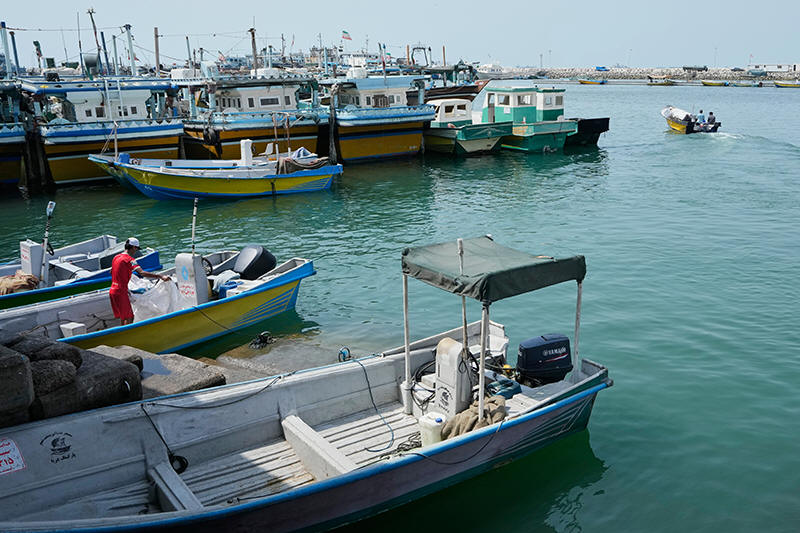
A man works aboard a boat as a motorboat leaves a harbor in Bandar
Abbas, Iran, Sunday, Sept. 6, 2026. (AP Photo/Vahid Salemi)

Tehran could escalate in other ways
The tightened blockade and new U.S. sanctions are already taking a
heavy toll on Iran's economy, driving up prices and causing even
longer lines outside gas stations.
But so far, it's shown no sign of pushing the country's increasingly
hard-line leaders to make concessions on the Strait of Hormuz,
Iran's disputed nuclear program or its support for armed groups in
the region.
“Washington’s main problem is that it still lacks a theory of
victory: More ships are getting through, and Iran is hurting, yet
none of that has produced a political outcome,” said Ali Vaez, an
Iran expert at the International Crisis Group think tank.
Iran has continued to attack ships in the strait, drawing limited
U.S. strikes on its coastal areas and then responding with missile
attacks on Arab countries hosting U.S. forces. Trump recently
dismissed the conflict as “small potatoes.”
But with the U.S. supply of sophisticated interceptors showing
strain, Iran could be tempted to escalate its attacks — or respond
through regional proxies.
The Iran-backed Houthis launched a wave of attacks on Saudi oil
facilities this week as part of a conflict that goes back more than
a decade but has heated up in recent weeks. The Houthis are also
attacking Saudi shipping, threatening its oil exports and a crucial
trade route through the Bab el-Mandeb chokepoint leading to the Red
Sea and the Suez Canal.
The Houthis have damaged Saudi Arabia's Jizan refinery, a large
supplier of diesel and jet fuel to Europe, Falakshahi said. The
volume of Saudi oil passing through the Bab el-Mandeb bound for Asia
has plunged from around 3.4 million barrels a day in June to just
128,000 in August, according to Kpler's figures, though it has
recovered slightly to some 700,000 barrels per day in September.
“Tehran has repeatedly signaled that it will respond to growing U.S.
pressure by moving up the escalation ladder, not by backing down,”
Danny Citrinowicz, a senior researcher at Israel's Institute for
National Security Studies and a former Israeli intelligence officer
focused on Iran, wrote on X.

“Iran will not simply accept an indefinite maritime blockade, nor
will it allow Washington to impose mounting economic costs without
imposing costs of its own,” he wrote.
___
Krauss reported from the Middle East for more than 20 years, with
postings in Cairo, Jerusalem and Baghdad.
All contents © copyright 2026 Associated Press. All rights reserved |