UK lawmakers vote down bill to allow assisted dying in England and Wales
[September 12, 2026]
By PAN PYLAS
LONDON (AP) — U.K. lawmakers on Friday voted down legislation to allow
terminally ill adults in England and Wales to choose to end their lives.
Following an impassioned four-hour debate in the elected House of
Commons, the Terminally Ill Adults (End of Life) Bill was rejected 286
to 270. The outcome was somewhat surprising given that an almost
identical bill had passed last year with a margin of 23 votes.
The vote brings an end to a two-year debate in Parliament about assisted
dying, during which the House of Commons had backed assisted dying on
two previous occasions. Their backing wasn't enough for it to become law
because it was effectively filibustered by unelected lawmakers in the
House of Lords.
Back in the House of Commons on Friday, the bill had proposed allowing
adults in England and Wales who have fewer than six months to live to
apply for an assisted death subject to the approval of two doctors and
an expert panel.
Many individual lawmakers relayed their own stories both in favor of and
against the proposal. The government took a neutral stance, meaning
lawmakers voted according to their consciences rather than along party
lines.
One lawmaker who was among those to oppose the bill, having previously
backed it, spoke about how “nightmares” prompted her to switch sides.
Janet Daby said she dreamed of “dying and death” because she had not
been “entirely comfortable” with her former position.

The new U.K. leader, Prime Minister Andy Burnham, didn't vote because he
said he didn't want to “unduly influence the debate.”
Opponents branded the bill unsafe and unworkable, citing concerns around
potential coercion of vulnerable people and a lack of safeguards for
those with disabilities.
Lawmaker and cancer surgeon Dr. Zubir Ahmed also noted uncertainty
around a doctor’s prognosis.
“I have to be honest with you,” he said. “When I am asked to
prognosticate as to whether someone has six months to live or not, I am
as often wrong as I am right.”
[to top of second column]
|
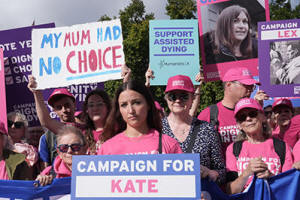
Campaigners gather to protest in support of assisted dying, in
Parliament Square, central London, Friday Sept. 11, 2026. (Stefan
Rousseau/PA via AP)
 The leader of Catholics in England
and Wales, Archbishop Richard Moth, called the bill “wrong in
principle” and “deeply flawed. The Church of England’s Archbishop of
Canterbury, Sarah Mullally, also objected to the bill.
Medical colleges, including the Royal College of Psychiatrists, had
raised “serious concerns” about the bill, saying there were “too
many unanswered questions about the safeguarding of people with
mental illness.”
Proponents of “ assisted dying ” — sometimes referred to as
“assisted suicide” — had hoped it would mark the biggest change to
social policy in the U.K. since abortion was partially legalized in
1967. The intention was to put an end to the practice of those near
the end of their lives going to other countries, such as
Switzerland, for an assisted death.
Lauren Edwards, who reintroduced the bill to the House of Commons,
said the rejection was “heartbreaking” but expressed hope that the
issue will win parliamentary approval in the future.
“Assisted dying will come in this country, as it is already doing
all across the world, but not soon enough,” she said. “Parliament
has dropped the ball today. It will be picked up again as it must
be, because the law as it stands is simply too cruel and too unjust
to be allowed to stand.”
Other countries where assisted dying is legal include Australia,
Belgium and Spain, with regulations on qualifying criteria varying
by jurisdiction.
All contents © copyright 2026 Associated Press. All rights reserved |