Want to lower your risk of dementia? It doesn't involve a blood test
[September 14, 2026]
By LAURAN NEERGAARD
WASHINGTON (AP) — New blood tests that might predict Alzheimer’s years
before symptoms begin may sound tantalizing for people who worry about
later-in-life dementia. But doctors say they aren't quite ready yet —
and besides, you don’t need a test before trying to lower your risk.
The U.S. Food and Drug Administration has cleared four blood tests to
help doctors diagnose whether Alzheimer’s — not another kind of dementia
or something else — is behind someone’s memory problems or other
cognitive symptoms. Some laboratories and online services offer their
own tests. Faster diagnosis can help people with early-stage Alzheimer’s
qualify for drugs that can modestly slow the worsening of their
symptoms.
Yet dementia specialists say people without symptoms also seek those
tests even though they’re neither approved nor recommended for that
population.
For now, “the worried well should not be getting those tests” outside of
a research study, stressed testing expert Nicholas Ashton, of Arizona’s
Banner Health.
Instead, focus on addressing potentially preventable brain risks. One
large study found people who reached middle age without high blood
pressure, diabetes and smoking lived dementia-free for a lot longer —
nearly 13 years longer — than people with all three of those common
health problems in their 50s.
“Be aggressive,” advised Dr. Josef Coresh of NYU Langone Health, the
study’s senior author. Even delaying those risky conditions “has a huge
payoff.”
What Alzheimer’s blood tests can and can’t do
Like many people who have watched a loved one succumb to Alzheimer’s,
Mark Yost wonders about his own risk even though he doesn’t have
symptoms.

“I want to know what my status is,” said Yost, 60, of Phoenix. And if
signs of trouble develop, “what I can do about it to either avoid it or
slow it down.”
It's not clear what causes Alzheimer's, but its telltale markers are
abnormal forms of two proteins. Sticky beta-amyloid can build into
brain-clogging plaque over decades, eventually spurring neuron-killing
tau tangles that lead to symptoms. Blood tests that measure a tau type
called p-tau217 seem particularly good at reflecting amyloid buildup in
people with symptoms.
As for the symptom-free, a study led by Mass General Brigham researchers
found older adults with very high p-tau217 levels had a 38% risk of
developing cognitive impairment within five years, and a higher risk
over 10 years.
Here’s the rub: A “positive” test result is just a risk factor, not a
guarantee someone will later develop Alzheimer’s, Ashton cautioned. Lots
of older adults harbor high levels of amyloid but never show cognitive
trouble. And while negative test results seem pretty reliable, a
positive test sometimes is wrong, a so-called false positive.
[to top of second column]
|
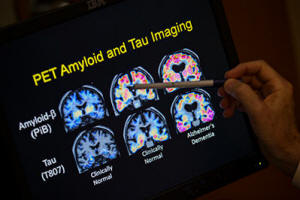
A doctor points to PET scan results that are part of a study
on Alzheimer's disease at Georgetown University Hospital, on
Tuesday, May 19, 2015, in Washington. (AP Photo/Evan Vucci, File)
 Yost volunteered for a Banner blood
test study that included cognitively normal people and learned his
result was “intermediate,” defined as maybe having some amyloid but
not a worrisome “elevated” level.
Yost found the uncertainty “a little disappointing” and something to
watch as he gets older, while pursuing brain-healthy steps like
exercise and a mentally stimulating genealogy hobby.
What everyone should do for brain health, no test needed
A major trial last year found that healthier habits slowed
age-related cognitive decline in older adults who were at increased
risk of developing dementia. Among the steps: A half-hour of
moderately intense exercise four times a week, twice-weekly
resistance training and following the MIND diet, which stresses lots
of leafy greens and berries, whole grains, poultry and fish.
Dementia experts also advise getting enough sleep, avoiding social
isolation, treating hearing loss and exercising your brain, not just
your body. They say middle age is a key time to act.
As for those extra 13 dementia-free years, the NYU study reinforces
that what's good for the heart is good for the brain.
Coresh's team analyzed health records of more than 12,000 people who
had been tracked for decades since they were, on average, age 56.
High blood pressure, Type 2 diabetes and smoking can damage blood
vessels that feed the brain and fuel inflammation. Those who entered
the study without those three problems fared best, but avoiding one
or two was helpful. Even people who carry the APOE4 gene, which
increases the risk of later-in-life Alzheimer's, still benefited
from a healthier middle age.
Other studies also have shown that aggressively treating high blood
pressure helps brain health.
“Be very serious with your physician about the value of lowering it
as early as possible for as many years as possible,” Coresh said.
As for those Alzheimer's blood tests, stay tuned. Clinical trials
are underway to tell if drugs now used to treat Alzheimer's might
also help certain people before they develop symptoms — findings
that could change testing advice.
All contents © copyright 2026 Associated Press. All rights reserved
 |