Iranian cargo ship is struck, and talks between Tehran and its neighbors
are postponed
[September 14, 2026]
By SAMY MAGDY, SALLY ABOU ALJOUD and CARA ANNA
CAIRO (AP) — An Iranian cargo vessel was struck early Sunday off Qeshm
Island in the Strait of Hormuz, Iranian state media said, and Tehran
postponed a plan to brief neighboring countries on its contested efforts
to manage shipping in the strait.
The attack drew attention back to the strait after threats to shipping
in the Red Sea intensified last week. Iran-backed Houthi rebels battling
government forces in Yemen captured an island on the Bab el-Mandeb
Strait, a crucial shipping alternative to the Strait of Hormuz.
Iran's state-run IRNA news agency quoted the Qeshm governor as blaming a
“terrorist enemy” for Sunday's attack, which it said killed one and
wounded four.
There was no immediate comment by the U.S. military, which has struck
Iranian-flagged vessels during its blockade of Iranian ports and faces a
new threat from Iranian ballistic missiles launched at its warships.
Qeshm Island, about 14 miles (22 kilometers) from the port city of
Bandar Abbas, is key to Iran asserting control over the Strait of
Hormuz.
Hours before the attack, Iran’s government remained defiant. “Our people
can’t be bullied into submission. Iran won’t surrender,” President
Masoud Pezeshkian said in a social media post.
U.S. President Donald Trump disagreed, saying on Sunday that Iran “wants
to make a deal so bad” that “they’re calling constantly.” Trump spoke at
his golf course in Doonbeg, Ireland, where he was attending a
tournament.
Later, when asked by a reporter whether the U.S. struck the Iranian
cargo vessel early Sunday in the Strait of Hormuz, Trump said: “I don’t
want to say.” He then boarded Air Force One to head back to Washington.

Iran aims to brief regional countries on the strait
Iran had said foreign ministers from regional countries would meet
Monday in Oman to discuss efforts by Iran and Oman, located on the other
side of the strait, to manage shipping on it. But the foreign minister
of Oman, Badr Albusaidi, said on X late Sunday that the meeting had been
postponed “in the interests of consensus.”
Iran and Oman agreed to postpone the talks “at the request of some
regional countries,” said Mohammad Ali Bak, an official in Iran’s
foreign ministry who was quoted by IRNA on X.
Saudi Arabia has submitted amendments to the Iran-Oman agreement, citing
concerns that the emerging deal could have lasting implications for the
Strait of Hormuz that could negatively impact other Gulf Cooperation
Council countries, according to a Gulf official familiar with the matter
who was not authorized to comment publicly and spoke on the condition of
anonymity.
Commercial ship traffic remains low in the Strait of Hormuz as attacks
continue on what was seen as an international waterway before the U.S.
and Israel launched the war on Feb. 28.
[to top of second column]
|
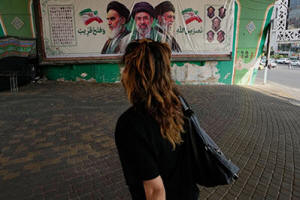
A woman walks past a banner showing portraits of the late Iranian
revolutionary founder Ayatollah Khomeini, left, Supreme Leader
Ayatollah Mojtaba Khamenei, center, and the late Supreme Leader
Ayatollah Ali Khamenei in northern Tehran, Iran, Saturday, Sept. 12,
2026. (AP Photo/Vahid Salemi)

The United Kingdom Maritime Trade Operations monitor said Sunday that a
vessel was hit by a projectile while transiting the strait, though it
wasn’t clear if this was referring to the attack Iran had reported off
Qeshm. The monitor said a severe fire had broken out and that local
authorities were evacuating those on board.
The U.S. has asserted that plenty of oil is getting out as its military
helps to guide ships along Oman's coast, at the risk of being struck.
Before the meeting in Oman was postponed, only Iraq had publicly
confirmed plans to attend. Bahrain had said it would not attend, citing
a lack of diplomatic relations with Tehran.
Since early in the war, Iran has expressed interest in having ships pay
fees for transit. It has said traffic into the Persian Gulf would pass
through Iranian waters, while the outbound route would pass partly
through Iranian waters and partly through Oman’s.
There had been some optimism in the region about the planned meeting,
with hope that Gulf nations might use it to assert a collective response
to a war they had no part in starting. For months, they have faced
Iranian attacks that Tehran has claimed target U.S. military assets on
their lands.
On Sunday, Iran’s president said he had a “good talk” over the weekend
with a top official from the United Arab Emirates on the sidelines of a
global summit of leading developing nations.
Iran has fired thousands of missiles and drones at the Gulf country, a
close U.S. ally.
Pezeshkian said he met with Abu Dhabi’s crown prince, Sheikh Khaled bin
Mohamed bin Zayed, while attending the BRICs summit in New Delhi.
“We talked about the issues of concern so that it’s possible to put the
past behind us, to look toward the future and how we can build the
future together,” Pezeshkian said. His comments were aired live on
Iranian state television.
___
Anna reported from Jerusalem. Associated Press writers Amir Radjy in
Cairo, Melanie Lidman in Tel Aviv, Israel, and Aamer Madhani and Didi
Tang in Washington, contributed to this report.
All contents © copyright 2026 Associated Press. All rights reserved
 |