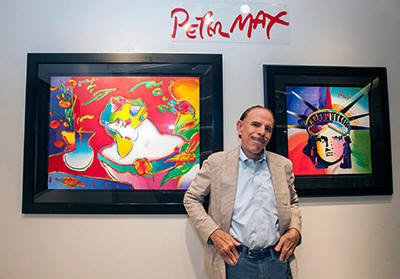
The psychedelic pop artist Peter Max has died at 88, his son says
[September 17, 2026]
By BETH J. HARPAZ
NEW YORK (AP) — Peter Max, whose colorful, psychedelic pop art expressed
the optimism of the “flower power” movement of the 1960s and graced
everything from postage stamps to a cruise ship, has died at 88, his son
said in a written statement Wednesday.
Max died on Monday, the statement said. No cause was given, but he had
been suffering from advanced dementia.
Max began his career in graphic design in the 1960s, and his swirly,
colorful, instantly recognizable designs epitomized the era’s “flower
power” art. But thanks to his prolific output and fun, accessible style,
Max’s work remained popular well into the 21st century.
Max was the official artist for the Olympics, the Super Bowl, the
Indianapolis 500, the World Cup, the World Series and many other events.
His art appeared on a Boeing 777 airplane and a Norwegian Cruise Line
ship. His portrait subjects ranged from U.S. presidents to Taylor Swift.
But in his first flush of success in the late 1960s and early 1970s, his
murallike tableaus of flowers, the cosmos and cartoonish figures — all
in vivid colors like turquoise, orange and neon green — seemed to be
everywhere. Dorm room walls were plastered with his posters. Household
furnishings like clocks and bedspreads sported his designs.
He even created covers for the Manhattan Yellow Pages, a business phone
directory distributed to millions of people. Max himself was featured on
the cover of Life magazine in 1969, his trademark dark, bushy mustache
framing a hearty grin.
“We will remember his extraordinary creativity, his warmth, his
curiosity, and the way he saw beauty and possibility everywhere,” his
son Adam Max said in the statement announcing the death. “His art became
part of American culture, but the man behind that art — the father we
knew and loved — is the person we will miss most.”

Family fled Nazi Germany
Max was born Peter Max Finkelstein in 1937 to a Jewish family in Berlin.
They fled Nazi Germany for Shanghai when he was a baby and later spent
time in Tibet, Israel and Paris before settling in New York City when
Max was 16. By then, he said in an interview, he was already “a huge fan
of American culture”: comics, movies and “all the jazz music.”
Max studied in New York at the Art Students League, the School of Visual
Arts and Pratt Institute. In 1961, he opened a graphic design studio
with friends. His bold, unique style was an immediate hit with ad
agencies, publications, the corporate world and in pop culture.
That led to a booming commercial business. "My work was really, I would
say, almost exploited," he said. "It was on mugs, it was on bedsheets,
it was on dresses, it was on silks and scarves and ties — 70 product
lines."
But what “bothered” him about all that success, he said, was that he
“wasn't painting anymore.” So he shut the business down for a time in
the early 1970s to reconnect with his art. One of his biggest projects
after returning to public life was a series of portraits of the Statue
of Liberty, painted at the White House at the invitation of first lady
Nancy Reagan in 1981.
[to top of second column]
|
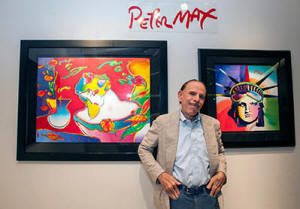
Artist Peter Max poses for a photo during his retrospective
with the Road Show Company exhibit, Sept. 6, 2014, in Northbrook
Court mall in Northbrook, Ill. (Photo by Barry Brecheisen/Invision/AP,
File)
 Max weathered various controversies
in his personal and professional life. He pleaded guilty to tax
fraud in 1997 after the IRS alleged he concealed more than $1
million in income from his art. He was originally sentenced to two
months in prison but ultimately was allowed instead to serve the
time in a work-release program, pay the back taxes and a $30,000
fine, and perform 800 hours of community service teaching art in
Harlem schools.
In 2015, his family life became tabloid fodder in a
back-and-forth between his second wife, Mary Max, and Adam, his son
from a previous marriage. The son and a guardian alleged that Mary
Max had depleted his finances and browbeat him. She in turn claimed
that they had kept him from her against his will and stolen
paintings that belonged to her. Accounts of court appearances
described him as frail.
In 2019, Mary Max died by suicide two weeks after The New York Times
published a story detailing legal battles over his work.
His art had a bright, happy vibe
Those dark allegations contrasted with the relentlessly bright,
happy vibe that infused his work. "The colors are strong, sometimes
loud, sometimes raw and sometimes harmonious, but always powerful,
and the images are always on the side of the peaceful nature,” he
said. “I don't discuss in my paintings negative things, I don't
dwell on it in my mind and don't dwell on it in my canvasses."
In another interview, he summed it up like this: "I see everything
through rainbow eyes."
Although accounts of Max’s career sometimes lament that he was not
taken seriously by the art establishment, in fact his work has been
featured in dozens of museum exhibitions around the world. New
York’s Museum of Modern Art owns seven of his works.
The art for the Beatles’ “Yellow Submarine” is sometimes mistakenly
attributed to Max, but the design for the album cover and “Yellow
Submarine” movie are officially credited to the late Heinz Edelmann.
Max claimed in a 2012 interview he did the original “Yellow
Submarine” design before handing it off to Edelmann. But the website
for New York’s Park West gallery, a longtime dealer of Max’s art,
described Max’s involvement in “Yellow Submarine” as “early
consulting work.”

Max was, however, friends with the Beatles and many other
celebrities. He also had a deep interest in Eastern spirituality. He
brought “Swami” Satchidananda Saraswati to the U.S., and helped him
popularize yoga here.
Max’s first marriage to Elizabeth Nance ended in divorce. In
addition to his son, he is survived by a daughter, Libra Astro.
All contents © copyright 2026 Associated Press. All rights reserved |