Artists, promoters and venues have their own kind of power on troubled
tours like Ed Sheeran's
[September 17, 2026]
By ANDREW DALTON and GARY GERARD HAMILTON
LOS ANGELES (AP) — Concert promoters wield great power. Venue owners can
too but they rarely choose to. And artists capable of filling stadiums
like Ed Sheeran usually have approval over everything that happens under
their name.
That's the consensus view of music business players who talked to The
Associated Press about how mammoth tours like Sheeran's generally work.
The singer's ongoing Loop Tour is mired in chaos after four supporting
acts quit in solidarity with rapper Macklemore, who was dropped for
making pro-Palestinian comments onstage at New Jersey’s MetLife Stadium.
Sheeran said on Instagram that the decision was made by the promoter,
and he had no power over it. The promoter said it had no choice because
venues wouldn't allow Macklemore to perform.
Robert Kraft, the billionaire owner of the New England Patriots and
Gillette Stadium, which is among the remaining tour stops, said in a
statement that the decision to drop Macklemore was a result of his
recent comments “and a broader history of antisemitic rhetoric and
imagery.”
The promoter and the artist share power
The promoter is the primary business actor on a tour. At high levels,
it's a company like Messina Touring Group, the promoter of Sheeran's
tour.
“The promoter puts up the money, pays all of the acts, deals with the
venue. They provide the stake, sell the tickets, and the artists come on
and play,” said Ray Waddell, chief content director for media and
conferences for the Oak View Group, an entertainment and venue
management company whose properties include the concert trade
publication Pollstar.

Sheeran said in his Instagram post that despite his attempts “to build a
bridge” all week, “the venue’s and promoter’s decision was final.”
But do promoters generally have the ultimate say for who is on the bill?
“If you’re paying for everything, yes you can make that call,” Waddell
said, “but almost without exception the promoter wants to do what the
artists want.”
Dean Sheldon Serwin, an entertainment lawyer who works in the music
industry, said that broadly speaking, “at the end of the day that
superstar headliner is going to have approval over everything.”
And the artist's power derives from their ability to fill arenas and
stadiums.
“The way to make money in the music industry for real is butts in seats,
always has been, always will be,” Serwin said. “How many tickets can you
sell and how consistently can you sell those tickets?”
But while it may be minimal with acts on the level of Sheeran or Ariana
Grande, there is still a transactional relationship.
“When you want to play at the venues you want to play at, there’s a give
and take,” Serwin said.
Lil Gary, a music artists manager who in the past worked in tour
management for acts including the Rolling Stones and the Eagles, said
touring musicians and their representatives would want say over “a great
many things especially when it comes to creative control, but when it
gets down to the minutiae, not very much.”
But she said on some nonmusical issues they’ll take a great interest.
“Artists of a certain stature, they would absolutely dictate how
security works,” she said as an example.
[to top of second column]
|

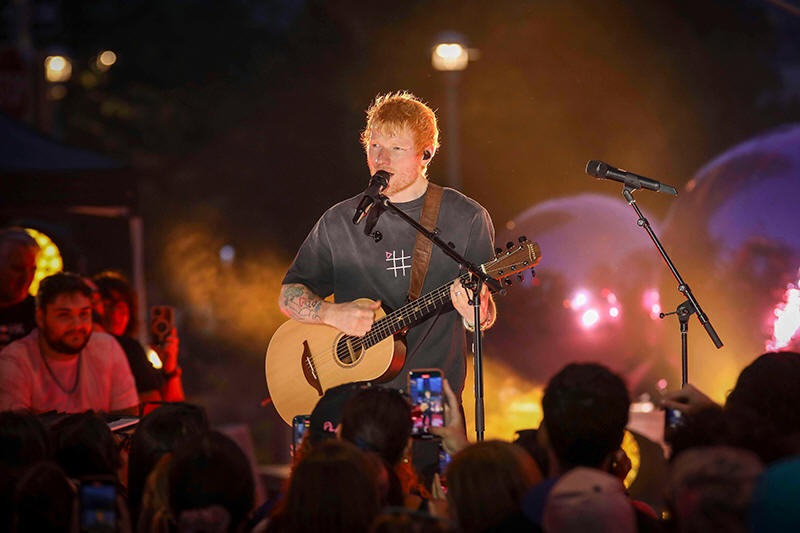
Singer-songwriter Ed Sheeran performs during "Ed Sheeran's Play:
Live from New York" presented by TikTok at Domino Square in the
Brooklyn borough of New York, Sept. 13, 2025. (Photo by Andy Kropa/Invision/AP,
File)
 She said it’s definitely very rare
in her experience for supporting artists to have any effect on how
the tour went or its fate.
“The opening acts that were on Rolling Stones tours, for the most
part they were happy to be there,” Gary said. “They just suited up,
showed up and did the job.”
Neither Gary nor Waddell nor Serwin are involved in the Sheeran
tour.
The stadium owners' role is usually silent
Venues and their owners like Kraft are usually hands-off players,
but they have say if they make the rare choice of wielding it.
“Certainly they can lock the doors,” Waddell said. “They usually
hand the keys to the promoter. The promoter comes in and does the
show whether it’s a club or a stadium, but that doesn’t mean they
vacate all power and influence.”
Waddell said venue operators, like promoters, are usually savvy and
can anticipate what an artist is likely to do or say based on past
performances.
“I don’t see why it surprised anybody given the history of the
artist involved,” he said. “That being said, I don’t know that
Robert Kraft was up on his Macklemore.”
“But,” Waddell said, “he got wind of it and he didn’t like it and
it’s his stadium.”
What if they have to cancel?
Concert tour cancellations are common but are usually based on
things like artists’ health. And ideally, there’s immediate
rescheduling with the very same tickets honored.
“That can’t always happen, but it is the best,” Gary said.
There is no strong evidence that Sheeran's entire tour is going to
be scrapped over the opening act issue.
But if it did, multiple insurance companies would likely be involved
in salvaging the aftermath.
The biggest artists generally have their own insurers, and the
promoter has its own, to take care of refunding fans and paying
people who are contractually owed.
“They would go to their respective carriers and sort out their
respective losses,” Gary said.
The circumstances could easily lead to blame and broken business
relationships, but Waddell said “they work it out because everybody
wants to work together again in the future.”

“Ed Sheeran’s young. He’s got a lot of tours ahead of him and these
tours make a lot of money,” he said. “It’s a business and it’s not
going away. Everybody’s going to be doing this next year and 10
years after that, God willing.”
___
Hamilton reported from New York.
All contents © copyright 2026 Associated Press. All rights reserved |