Carney embraces EU associate membership proposal as Trump pushes Canada
closer to Europe
[September 18, 2026]
By ROB GILLIES
STRASBOURG, France (AP) — Canadian Prime Minister Mark Carney on
Thursday embraced the prospect of his country becoming the European
Union’s first associate member, saying closer ties with the continent
would ensure no country could control Canada’s markets or undermine its
sovereignty.
Carney’s speech to the European Parliament repeatedly extolled
cooperation between Europe and Canada — but the relationship with the
U.S., which has defined Canada’s economy for decades and has
increasingly soured, hung over the address.
Trump’s tariffs, demands for economic concessions, and repeated talk of
making Canada the 51st state have pushed Ottawa to reduce its dependence
on its neighbor and seek a far deeper economic, security and political
relationship with Europe.
Carney told the parliament that he welcomed European Commission
President Ursula von der Leyen’s proposal, unveiled Wednesday, though he
acknowledged that “associate membership” remains to be defined.
He outlined what he was proposing: deeper integration across trade,
defense, critical minerals, artificial intelligence, energy, space,
research and financial services to make both sides less vulnerable to
economic and geopolitical pressure. He later told reporters he was not
pursuing full membership of the EU.
“We do not seek power to dominate others," he said. “On the contrary, we
are pursuing resilience so that no one can control our open markets,
impair our sovereignty, threaten our territorial integrity, or undermine
our freedoms, our democracies, our rule of law.”
The prime minister received an ebullient welcome when he walked into the
chamber in Strasbourg, France — with many lawmakers approaching him to
shake his hand and ask for selfies — and a standing ovation after he
spoke. One parliamentarian had donned a Canadian hockey jersey.

Europe offers Canada another path
On Wednesday, von der Leyen proposed making Canada the EU’s first
associate member — a status that does not currently exist in the bloc’s
treaties and would have to be created. She said Europe wants to take its
relationship with Canada to “the highest level possible.”
Carney, sitting in the front row of the chamber, nodded and rose to
embrace von der Leyen as lawmakers gave the proposal a standing ovation.
Von der Leyen said Canada and the EU should move beyond their existing
free trade agreement and create an “Alliance for the Future”
encompassing a “common prosperity and economic security space.”
Carney will host EU leaders for a summit in Montreal on Oct. 29-30, when
the two sides are expected to discuss the proposed new relationship in
more detail.
Canada sends roughly 70% of its exports to the United States, making it
highly exposed to Trump’s tariffs. Ottawa has retaliated and rejected
demands that Carney says threaten Canadian sovereignty.
Europe took a different path, shelving retaliation and accepting tariffs
of up to 15% on most EU exports to the U.S.
[to top of second column]
|
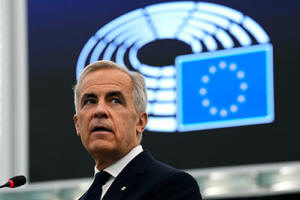
Prime Minister Mark Carney addresses the European Parliament in
Strasbourg, France, on Thursday, Sept. 17, 2026. (Justin Tang /The
Canadian Press via AP)

Trump pushed back on the EU proposal
Trump suggested the proposed EU arrangement could be a “hostile act”
and threatened heavy tariffs on Europe if he judged its intentions
to be unfriendly — raising the stakes ahead of Carney's speech.
Asked about Trump’s comments, Carney said Canadians were united in
rejecting outside attempts to dictate the country’s choices.
“Canadians are united that nobody is going to tell us what language
we speak. No one is going to dictate our culture or with whom we can
strike agreements internationally,” Carney said.
Carney has rallied ‘middle powers’
Carney has repeatedly urged what he calls middle powers to resist
economic coercion. At the World Economic Forum in Davos in January,
he warned that when countries negotiate alone with a dominant power,
“we negotiate from weakness. We accept what is offered.”
Trump rebuked him the next day.
Jonathan Wilkinson, Canada’s ambassador-designate to the EU, said
Ottawa wants “to get as close as we possibly can” to Europe while
increasing Canada’s independence.
While associate membership remains to be negotiated, Canada has
already taken a major step. This year it became the first
non-European country to join the EU’s 150-billion-euro
($173-billion) SAFE defense procurement program, giving Canadian
companies access to joint procurement as Europe increases defense
spending.
The two sides have also discussed closer cooperation on energy,
critical minerals, artificial intelligence and digital trade.
Carney said any enhanced partnership with the EU would be debated in
Canada’s Parliament and put to a final vote.
“The policies and rhetoric of the Trump administration are clearly
pushing both Canada and the EU to imagine a world without strong
U.S. leadership and to act accordingly,” said Daniel Béland, a
political science professor at McGill University in Montreal.
Nelson Wiseman, a professor emeritus at the University of Toronto,
said Europeans have long regarded Canada as a country that
understands the United States particularly well because of their
deep economic and political ties. Carney’s willingness to resist
Trump rather than quickly accept Washington’s demands has reinforced
that perception, he said.
“Carney’s shrewdness in dealing with Trump has captured Europe’s
attention,” Wiseman said.
___
Associated Press writer Lorne Cook contributed from Brussels.
All contents © copyright 2026 Associated Press. All rights reserved |