Duncan Sheik, Tony- and Grammy-winning 'Spring Awakening' composer and
pop star, dies at 56
[September 19, 2026]
By MARK KENNEDY
NEW YORK (AP) — Duncan Sheik, the Tony- and Grammy-winning
singer-songwriter who crafted the music for “Spring Awakening,” has
died. He was 56.
Sheik died Thursday night, according to a post on his Instagram page.
“The world has a lost a singular talent, and deeply influential voice in
music and theater,” the post reads. “His musical legacy will continue to
inspire generations to come.”
Sheik had been best known for his lasting radio hit “Barely Breathing”
when he turned his sights on Broadway with “Spring Awakening,” resulting
in the envelope-pushing show that musicalized teenage angst.
“With the exception of our director, we are all kind of Broadway
outsiders. We wanted to shake things up a bit. And we just set out to
make this really cool piece of theater,” Sheik told The Associated Press
in 2007, as the show swept Tony nominations.
Sheik also tackled musicals based on “American Psycho” and “Alice in
Wonderland,” and “Barely Breathing” spent 55 weeks on the Billboard Hot
100, peaking at No. 16. But he was probably best known for “Spring
Awakening,” which ran for over 860 performances on Broadway starting in
2006.
“His deep feeling and his delight gave us so much beauty,” playwright
and actor Eisa Davis wrote. “Duncan, thank you for your friendship and
for the sublime music.”

‘Spring Awakening’ roused a new side of Sheik — and Broadway
The musical — adapted from a 19th-century play by German playwright
Frank Wedekind, with music by Sheik and lyrics by playwright Steven
Sater — is frank in its portrayals of incest, abortion and suicide. It's
intended partly as a warning that teens need good information about sex
to avoid tragic mistakes.
“I don’t mean to be disrespectful to more traditional theater
composers,” he told the Los Angeles Times in 2015. “I love Stephen
Sondheim. But it’s my mission to make sure that the theater is paying
attention to what the rest of the world is listening to.”
Sheik and Sater were practicing Buddhists who met while chanting. They
were collaborating on Sheik's third album, “Phantom Moon,” when Sater
mentioned he was working on a new production. Neither had written a
musical before.
“I said to Steven, ‘I’m happy to do this musical, but I only want to do
it if the music in the play is the kind that I and my peers can get
behind stylistically and relate to and enjoy,’” Sheik told the AP in
2006.
They made a pact: They'd retain the provincial, 19th-century Germany
setting but with, as Sater put it, “the characters breaking into
pop-contemporary when they sing.”
“Spring Awakening” won eight Tony Awards, including best musical, as
well as the Grammy for best musical show album.
“Sheik’s music, spare in its simple orchestrations, lush in the lapping
reach of its seductive choruses, embodies the shadowy air of longing
that infuses the show, the excitement shading into fear, the joy that
comes with a chaser of despair,” The New York Times said in its review.
The show is beloved in the musical theater community for breaking ground
in staging and content, alongside the likes of “Rent” and “Hamilton.” It
returned to Broadway in 2015 in a well-received production by Deaf West
Theatre. An off-Broadway version is slated to open this fall, as is his
musical “Memoirs of Amorous Gentlemen,” based on Moyoco Anno’s manga of
the same name.
The cast of the original show was loaded with breakthrough actors like
Jonathan Groff, Lea Michele, Lilli Cooper, Jennifer Damiano, Gideon
Glick, John Gallagher Jr., Lauren Pritchard and Krysta Rodriguez, who
have each gone on to fame in TV, film and stage. Groff would go on to
earn a Tony with “Merrily We Roll Along,” and Michele became a superstar
with “Glee.”
Sheik blended musical theater with pop music
Sheik next channeled the music he heard getting past the velvet ropes of
trendy, late-1980s Manhattan clubs for a Broadway adaptation of the Bret
Easton Ellis novel “American Psycho.”
[to top of second column]
|
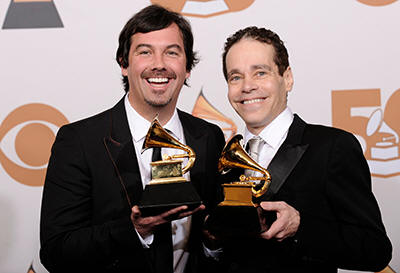
Duncan Sheik, left, and Steven Sater are seen with the award for
best musical show album for "Spring Awakening" at the 50th Annual
Grammy Awards on Sunday, Feb. 10, 2008, in Los Angeles. (AP
Photo/Mark J. Terrill, File)
 The 1991 novel — later made into a
2000 movie starring Christian Bale — chronicles a homicidal New York
yuppie named Patrick Bateman who is obsessed with high-end clothes
and beauty products even as he slashes his way through Manhattan.
Sheik, who also supplied lyrics, recalled only getting halfway
through the book before throwing it across the room as a Brown
University student.
For one standout song, “You Are What You Wear,” he reached out to
old girlfriends to ask a question: What were you really into wearing
in the late ’80s? He put the answers in the tune about high fashion:
“Chanel, Gaultier, or Giorgio Armani/Moschino, Alaïa, or Norma
Kamali/Should I rock/The Betsey Johnson/Or stick with classic/Comme
des Garçons?”
“Duncan is really a genius and an intellectual and brings something
both uniquely his but importantly of this period to the stage,”
producer Jesse Singer told the AP at the time.
Because Bateman, played onstage by Benjamin Walker, fancies himself
a bit of a music critic — spewing mostly inane ruminations about
Phil Collins and Huey Lewis and the News — Sheik also peppered his
score with sly reworkings of “In the Air Tonight” and “Hip to Be
Square.”
“There’s definitely an art to be able to write a song that on one
level is a pop song and one that also has to tell a story and keep
an audience engaged in terms of a larger narrative arc,” Sheik told
the AP in 2013. “When you’re writing a song for the theater, it has
to accomplish all this other stuff. It has to work in tandem with
all these other agendas and creative impulses.”
The show, directed by Rupert Goold and with a story by Roberto
Aguirre-Sacasa, made its premiere in 2013 in London. On Broadway in
2016, it bombed, lasting less than 90 performances.
“We were all sort of worried that it might be too violent for people
and it might seem too misogynist,” Sheik told the AP on the eve of
the opening. “But, in fact, the truth is this piece is a critique of
a certain way of thinking about things. So in truth it’s better to
go all-in.”
‘Barely Breathing’ was nominated for a Grammy
Growing up between South Carolina and New Jersey, Sheik learned
guitar as a child and got his first synthesizer when he was 12. He
was heavily influenced by Talk Talk, David Sylvian and Nick Drake.
His self-titled debut album was released in 1996 and Rolling Stone
gave it a four-star review, calling it “a defiant debut — beautiful
and benevolent of spirit.”

“Barely Breathing,” from that album, was nominated for best pop
vocal performance in 1998 and would be kept alive on TV shows like
“Glee” and “Girls.”
Other projects include “Whisper House,” an album and musical — a
ghost story that ran in 2010 at the Old Globe Theatre in San Diego —
and “Legerdemain,” an album that explored the tension between art
and commerce. His most recent album was 2022's “Claptrap.”
But for someone who had once been a total stranger to Broadway, he
told AP in 2016 that he had a sense of mission.
“I feel like it’s become my project to kind of drag different people
who might not normally go to musical theater pieces to come see a
piece of musical theater,” he said.
He is survived by his parents; his wife, Nora Ariffin; and a
daughter, Ines.
All contents © copyright 2026 Associated Press. All rights reserved |