Trump announces all 50 states joining Medicaid drug pricing model
[September 19, 2026]
By FATIMA HUSSEIN
WASHINGTON (AP) — President Donald Trump announced Friday that all 50
states will join in on a program set to provide Most Favored Nation
pricing to some drugs within the Medicaid program, bringing the net
price of selected drugs down to prices paid in certain other countries.
The Trump administration claims that Medicaid will save billions on
prescription drug costs as a result of the plan, dubbed the Medicaid
“GENEROUS” model. Experts say the savings are unclear since the content
of the deals isn't public.
“This one thing alone should win us the midterms,” Trump told reporters
in the Oval Office Friday, flanked by Health and Human Services
Secretary Robert F. Kennedy Jr., Centers for Medicare & Medicaid
Services Administrator Mehmet Oz and others.
Friday's announcement comes as cost-of-living issues are at the
forefront of voters’ concerns ahead of the midterm elections in
November. In a way to address affordability concerns, Trump has cut
deals with pharmaceutical companies so that the cost of some drugs in
the U.S. would not be dramatically higher than in other affluent
nations. But critics say his administration has not presented a viable
plan for broadly addressing rising health costs, especially after
Republicans let expire Affordable Care Act subsidies earlier this year
that sent plan costs soaring.
Last year, Trump signed an executive order instituting a “Most Favored
Nations” policy, where the U.S. would commit to paying the same price
for medications as the nation that pays the lowest price anywhere in the
world.
The White House in May estimated that Trump’s deals with pharmaceutical
companies to lower some of their U.S. prescription drug prices to levels
charged in other countries could save $529 billion over the next 10
years.
Patients in Medicaid, the state and federally funded program for people
with low incomes, already pay a nominal co-payment of a few dollars to
fill their prescriptions, but lower prices could help state budgets that
fund the programs.

Trump said, “Every state will have the ability to use those extra
billions of dollars to invest in other healthcare improvements or
something else.”
The true cost of the claimed savings is unclear since few details of the
deals struck by the Trump administration and participating
pharmaceutical companies have been made public, making it hard to
independently verify the projected savings.
[to top of second column]
|
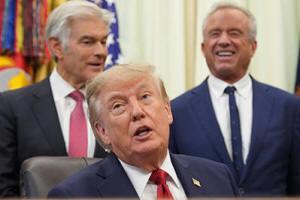
President Donald Trump speaks as Mehmet Oz, administrator of the
Centers for Medicare & Medicaid Services,, left, and Health and
Human Services Secretary Robert F. Kennedy Jr. listen during an
event about healthcare in the Oval Office of the White House, Friday
Sept. 18, 2026, in Washington. (AP Photo/Jacquelyn Martin)
 Kush Desai, a White House spokesman,
pointed to drug deals negotiated during former President Joe Biden's
term under the Inflation Reduction Act that did not include
commercially sensitive information and said experts "now poking
holes at the Trump administration for also not wanting to disclose
commercially sensitive information should be regarded as either an
idiot or partisan hack."
Kathy Hempstead, a senior policy adviser at the Robert Wood Johnson
Foundation, told The Associated Press that there is significant
pressure on the administration to provide more granular data to
justify its cost-savings claims, and that the lack of information
creates a barrier to legislative action.
“He is saying Congress should codify all of his MFN arrangements,”
Hempstead said. “But it’s kind of unreasonable because it’s not
clear what Congress would actually do. No one knows what is in these
deals.”
She added that there is concern about whether the current
administration’s tenure will affect the longevity of these price
cuts and whether prices will revert once the administration leaves.
Some want to see more people benefit from lower drug pricing.
JD Hayworth, a former Republican congressman and spokesperson for
the Pharmaceutical Reform Alliance, said in a statement that
Friday's announcement reflects “meaningful progress, but that
progress remains incomplete,” as millions of Americans not enrolled
in government healthcare want lower drug prices.
Drug prices for patients in the U.S. can depend on a number of
factors, including the competition a treatment faces and insurance
coverage. Most people have coverage through work, the individual
insurance market or government programs like Medicaid and Medicare,
which shield them from much of the cost.
All contents © copyright 2026 Associated Press. All rights reserved |