Trump decries Democrats as 'communists,' even as he looks to impress
China's communist leader
[September 21, 2026]
By MICHELLE L. PRICE and WILL WEISSERT
WASHINGTON (AP) — Communism, President Donald Trump says, is the
greatest threat the U.S. has ever faced.
This summer, citing similarly grave concerns, he took the rare step of
delivering a primetime address to the nation, accusing China of
“sinister election meddling” in 2020 and reviving his yearslong push to
dispute his loss in that year's election.
Even as Trump seeks to decry Democrats as communists ahead of November's
midterm elections, he is rolling out the red carpet this week for
Chinese President Xi Jinping, the leader of the world’s most powerful
communist country.
The state visit comes as the president himself has increasingly directed
his administration to take large stakes in private companies to try to
stimulate the economy — something even some Republicans decry as
corporate socialism.
The contradictions between Trump's words and actions risk muddying
Republican attack lines on Democrats.
“I do think that we’re not offering a clear contrast," said Marc Short,
who was chief of staff to former Vice President Mike Pence and worked in
Trump's White House in his first term.
Trump and the GOP argue Democrats have moved too far left
During the recent Republican midterm convention in Dallas, the president
repeatedly branded Democrats as communists, even proclaiming, “It’s
going to be a communist country if they win.”
“In state after state, the Democrat establishment has been overthrown
and replaced by crazed lunatics and radicals,” he said, adding, “America
has beaten communism before, and we will beat it again."

That's a reference to candidates aligned with democratic socialists who
won Democratic primaries in Michigan, Colorado, New York, Florida and
Pennsylvania. Trump and other Republicans argue it shows the party is
too extreme, although they exaggerate many of the political realities.
It is a way to shift the narrative in the face of a series of drags on
the popularity of Trump and his party with Election Day looming. Those
include an increasingly unpopular war in Iran, concerns about inflation
remaining high and Trump’s approval ratings retreating to near historic
lows.
Meanwhile, Trump has taken government stakes in private companies
The White House secured agreements giving the federal government stakes
in more than 30 companies — including nuclear power producer
Westinghouse, metals and element concerns and chipmaker Intel. It has
ignored the criticism that this strategy aligns it more with centrally
planned economies than capitalist ones.
“If socialism is government owning the means of production, wouldn’t the
government owning part of Intel be a step toward socialism?” Sen. Rand
Paul, a Kentucky Republican and frequent Trump antagonist, wrote on X.
During a recent House committee hearing, Connecticut Democratic Rep. Jim
Himes told Treasury Secretary Scott Bessent, “I can think of no
administration in the last 50 years that is quite as communist as the
Trump administration."
The president insists more such agreements are coming. “I will make
deals like that for our Country all day long,” he posted.
The White House didn't answer questions on whether it saw discrepancies
between Trump talking about denouncing Democrats as communists while
expressing fondness for Xi and having the government take large stakes
in private companies.
Short, the former Pence aide who is now chairman of the conservative
advocacy group Advancing American Freedom, said he thinks Republicans
are taking “very legitimate attack lines" by painting Democrats as being
too far left.

But he said the administration risks “picking winners and losers in the
economy" with its private company stakes, as well as with Trump's
proposal to send $5,000 to every adult American if the GOP retains
control of Congress after November, and his push for price controls on
goods such as pharmaceuticals.
“I think those policies, you know, lead to enormous, enormous
intervention from the government into the economy," Short said. But he
made it clear that he believes the measures don't come close to making
the U.S. into a socialist economy like China.
[to top of second column]
|
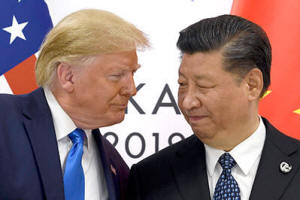
President Donald Trump, left, meets with Chinese President Xi
Jinping during a meeting on the sidelines of the G-20 summit in
Osaka, Japan, June 29, 2019. (AP Photo/Susan Walsh, File)

Trump rushed to finish White House helipad in time for Xi
Even as he criticizes Democrats for cozying up to communists, Trump
has bragged about his close relationship with China's leader, his
chief global rival. When he was in Beijing in May, the president
talked effusively about what “an amazing time" he had.
He’s not been shy about underscoring that he was building a
helicopter landing pad he calls a “work of art” on the south lawn of
the White House to impress Xi, while lamenting that his White House
ballroom wouldn't be completed in time.
“I can tell you this: It’s too bad we don’t have the ballroom open,”
Trump said Friday.
The president also has recalled visiting the Great Hall of the
People while in China, and suggested the ballroom might become the
“Great Hall of the United States.”
Trump's admiration for Xi is part of his fascination with strongmen,
said Marc Selverstone, director of presidential studies at the
University of Virginia’s Miller Center of Public Affairs. Trump has
also boasted about his warm relationships with North Korea’s Kim
Jong Un, Viktor Orbán in Hungary and Russian President Vladimir
Putin.
“His interest in strongmen who are communist and strongmen who are
not communists,” Selverstone said. “That’s constant, and playing to
them is not unfamiliar to Trump.”
Trump criticized Obama for welcoming Xi to the White House
There is often some disconnect between the high and delicate
diplomatic stakes of a summit during an election season — as
evidenced by Trump himself the last time Xi came to Washington for a
state visit.
In 2015, as then-President Barack Obama was preparing to host Xi,
Trump — in the midst of his first run for president — criticized the
pomp.
“Just take them to McDonald’s and go back to the negotiating table,”
Trump said then, during a rally in South Carolina. He later conceded
on Fox News Channel that Xi might at least be worthy of getting
"probably a double-size Big Mac.”
After he won the presidency, though, Trump's tone has shifted. By
2018, he was even marveling at Xi's position in communist China,
remarking that “He’s now president for life," during a GOP
fundraiser at Mar-a-Lago.

Trump's July speech was critical of China. But that didn't last
Trump briefly appeared to buck his soft spot for Xi in July during
his national address when he announced the declassification of
documents he said showed a pattern of China interfering in U.S.
elections.
“Our elections were left vulnerable to being rigged and stolen,”
Trump said, without criticizing Xi or calling for penalties against
China.
The documents ultimately didn’t reveal much new information, or
support Trump's claims. And the president has since tried to
downplay the alleged election meddling.
"It took place a long time ago. I think China is maybe a little bit
different today than it was then,” Trump said days after the speech.
Senior administration officials declined to comment on whether
accusations of Chinese meddling in the 2020 election would come up
during Trump’s discussions with Xi. But it's unlikely that the
politics of the midterms will have much impact on the summit, said
Ali Wyne, a senior research and advocacy adviser on U.S.-China
relations at the International Crisis Group.
“President Trump was very quick, in the aftermath of the (July)
speech, to focus his ire on the mainstream media, Democrats. He
didn’t condemn President Xi,” Wyne said, further noting that, when
it came to Beijing, Trump made it "clear that the U.S. relationship
was still on track.”
All contents © copyright 2026 Associated Press. All rights reserved |