Free operations give hope to children with a neglected but deadly
disease in Africa
[September 22, 2026]
By OPE ADETAYO and TUNDE OMOLEHIN
SOKOTO, Nigeria (AP) — Ibrahim Dalhatu was just 3 years old when he
contracted noma, a severe disease that disfigures the face and kills
most of the children it infects.
He had his first facial reconstructive surgery in 2021 at the Noma
Children Hospital in Nigeria's Sokoto state. Since then, Ibrahim, now 8,
has had six operations to help him recover.
Noma is a rapidly progressing and often fatal infection of the face and
mouth. It begins with gum inflammation in malnourished children living
in polluted environments and quickly spreads to destroy soft tissues and
bones. It mostly affects 2- to 6-year-old children, especially in poor
communities.
Early-stage treatment includes antibiotics, wound care and improved
nutrition. But once the disease worsens, surgery is required.
In Nigeria, health workers are seeing more noma patients. Doctors
Without Borders, the humanitarian organization known by its French
abbreviation MSF, is carrying out multi-stage operations free of charge
as part of its efforts to tackle diseases.
Parents say the operations have given their children another chance to
live a normal life, a relief for many in one of the world's poorest
regions.
“I was very excited because I thought there was no solution to the
disease,” said Muhammad Dalhatu, Ibrahim's father, an Islamic teacher
married to a trader. “Before, I was worried about the cost of the
treatment, but when I was told it was free of charge, I was so happy.”

A neglected disease rooted in poverty
Noma is classified by the World Health Organization as a neglected
tropical disease, meaning it receives little or no global attention and
funding, despite its impact on victims. WHO has said evidence shows the
disease “can be greatly reduced by early treatment.”
WHO has not updated its data on noma since 1998, when it estimated
140,000 cases per year with a 90% fatality rate. A study published in
July in The Lancet Global Health journal, relying on data from the
Sokoto hospital, reported over 50,000 noma cases across 12 northern
Nigerian states between 1999 and 2024.
While it is hard to track how common the disease is in different
countries, a so-called “noma belt” stretches across Africa, from Senegal
and Mauritania in the west to Ethiopia in the east.
Yuka Makino, a technical officer for oral health at the agency’s Africa
office, said research has shown that noma can be caused by 117 different
microorganisms, calling it “an opportunistic, polymicrobial infection.”
But the major risk factors, experts say, are extreme poverty and severe
malnutrition. WHO calls the disease “a marker of absolute poverty.” The
United Nations Human Rights Council says the conditions leading to it
constitute a human rights violation for affected children.
During the United Nations General Assembly, which begins Tuesday, WHO
has said it will engage heads of state and partners to raise global
awareness and advance shared solutions to diseases and other health
challenges.
[to top of second column]
|
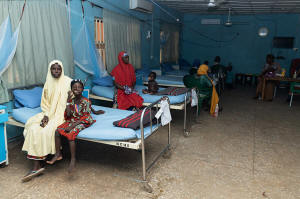
Hajira Sahabi, 2nd left, and other children who underwent facial
reconstructive surgery to help them recover from noma disease, sit
with relatives at the Noma Children Hospital in Sokoto, northwest
Nigeria, Thursday, Sept. 3, 2026. (AP Photo/Ifeanyi Emmanuel)
 A worrisome trend takes hold in
northern Nigeria
In northern Nigeria, ravaged by the fallout from armed violence and
economic hardship, experts say more children are being diagnosed
with noma. Many of those affected arrive late for treatment due to a
lack of awareness and the deadly impact of the disease, MSF and
medical officials said.
“We are seeing more acute noma cases, and we are veering toward
awareness for the community so they can bring their children earlier
to prevent tissue loss and require reconstructive surgery later in
years,” said Bukola Oluyide, Nigeria medical coordinator at MSF.
According to WHO's Makino, Nigeria reports more noma cases than
other countries due to its specialist hospitals, large population
and a government-led response that likely ensures more cases are
reported than in most other countries.
Neither the federal Ministry of Health nor the state ministry for
Sokoto responded to a request for comment regarding the government's
plans to combat the disease.
At the specialist hospital in Sokoto, more than 500 children with
noma from across northern Nigeria were treated between 2023 and
2025, according to data seen by the AP. Others are waiting for
surgery at the three sessions MSF runs each year for the children
whose bodies can take it.
“It is quite worrisome,” said Dr. Abubakar Abdullahi Bello, the
chief medical director of the Noma Children Hospital. “The disease
damages the mouth tissues within a short period. It eats up the
tissue within two weeks of onset if the patient does not receive
treatment.”
Ibrahim has largely recovered. He can eat and speak normally after
nasal fistula surgery, but not every child has the same opportunity.
Nigeria has only two noma hospitals, including one in Abuja,
recently built in 2023.

Maryam Sabiu's 4-year-old son, who was infected with noma in 2024,
is one of those on the waiting list. The disease has created a hole
in his left cheek, extending toward his left eye, but he is too
young for surgery. He is in pain and cries constantly. His mother
breastfeeds him frequently to soothe him. This has led to pain and
stigmatization, she said.
“I feel like the way people would stop and look at my child is one
of the worst experiences in my entire life,” Sabiu said.
All contents © copyright 2026 Associated Press. All rights reserved |