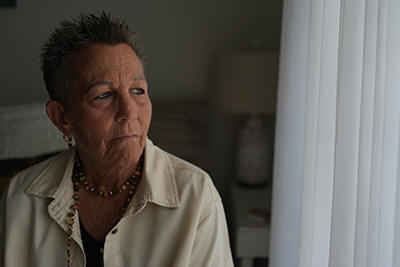
She lived to see ‘Deb’s law’ take effect. Now she can choose how she
dies
[September 23, 2026]
By LUIS ANDRES HENAO
CHICAGO (AP) — Deb Robertson counted the days, hoping she’d live long
enough for a new Illinois law to go into effect that allows terminally
ill people like her to use a lethal prescription to end their lives.
A diagnosis of a rare, aggressive form of cancer had forced her into
retirement after three decades of working with homeless youth. As the
disease quickly spread through her body, she felt “like a walking time
bomb.” But she found a new purpose, becoming a public face of a movement
in favor of life-ending options.
She shared her story publicly and traveled from her home near Chicago to
Springfield, the state capital, to convince lawmakers it was vital to
legalize medically assisted death.
The day came on Sept. 12. She celebrated at home with friends and family
as “Deb’s law,” named after her, took effect. Illinois became the first
Midwestern state and the 13th state overall (plus the District of
Columbia) to authorize the option.
“I believe that God gave me this extra time so that I could see this law
through,” said Robertson, 68. “I believe that people have the right to
leave this Earth with dignity and on their own terms.”
In recent years, the practice of allowing doctors to help terminally ill
patients end their lives with medication has been legalized in several
countries, with many more considering it. In the U.S., New York and
Illinois recently became the latest states to join an accelerating pace
of such legislation.
The issue remains bitterly contested
Opponents, including many religious groups, lawmakers and disability
advocates, have moral objections to someone ending their life. Even with
safeguards in place, some argue, the decision could be made for the
wrong reasons.

“It puts people like myself — people with developmental and mental
disabilities, as well as physical disabilities — in danger,” said Ebony
Payne, a Chicago-based disability advocate who is quadriplegic. She was
a plaintiff in a lawsuit against “Deb’s law,″ contending it
discriminates against people with disabilities.
Even Pope Leo XIV weighed in, urging Gov. JB Pritzker not to sign the
bill. Leo later said he was “very disappointed” that his home state of
Illinois approved a law condemned by the Catholic Church. Polls show
that most Americans think medical aid in dying is either morally
acceptable or not a moral issue, although opinions vary across different
faiths and political lines.
Dr. Jessica Kaan, medical director for End of Life Washington, an
advocacy group, has helped hundreds of patients in Washington and Oregon
with assisted dying.
Her mother, a practicing Christian, opposes it on religious grounds:
“She’s horrified that I’m involved in any way.”
Kaan says she’s an advocate for choices. Her perspective is shaped by
the types of deaths she has witnessed.
Among them are patients with ALS, a progressive disease that attacks
nerve cells controlling muscles throughout the body. “It’s a
particularly gruesome and awful way for most people to even anticipate
their dying,” she said about a disease that takes away the body’s
ability to move and speak.
For many terminally ill patients, she said, having the option gives them
a sense of comfort, even if they eventually might not use it.
“I respect that people don’t want to choose that as an option for
themselves. What I don’t love is for people trying to police that for
other people.”
How a California man prepared to die
Peter Redgrove of San Diego, a late-stage bone marrow cancer and
leukemia patient, used California’s assisted-dying law on Sunday. After
19 rounds of chemotherapy, he decided to set the terms of his death
following a long, pain-wracked hospital stay.

“I see no point in enduring pain and suffering emotionally,
psychologically and physically, when there are means to end it,” said
Redgrove, 85, days before he took the lethal prescription cocktail in a
cup emblazoned with Sylvester, his favorite character from the Looney
Tunes. “I don’t think you get extra points for hanging in to the bitter
end.”
Redgrove grew up in Catholic orphanages in England before moving to the
U.S. Although he was no longer a practicing Catholic, he remained close
to his faith, often wearing a crucifix he only gave away right before
his death.
“An all-loving God is not going to punish me and throw me into a fire
pit because I’m doing this,” Redgrove said in his room at a residential
facility, where he spent his last days listening to classical music and
reminding people to be kind.
With a death doula’s help, he invited loved ones to a celebration of his
life that included Champagne, a shroud to wrap his body in his favorite
royal purple and a final song: “Time” by The Alan Parsons Project.
Before he took his last breath, he read a Buddhist prayer.
State by state, the movement has spread
Oregon was the first U.S. state to pass a medical aid-in-dying law; it
took effect in 1997.
As other states followed suit, what remains generally consistent is that
to use the laws, one must have an incurable illness and less than six
months to live, said Thaddeus Pope, a bioethicist at Mitchell Hamline
School of Law in St. Paul, Minnesota. To qualify, one must also be able
to understand and make a voluntary decision and be able to take the
prescribed medications without assistance.
The latest states to legalize medical aid in dying are among the most
populous: New York, where it took effect in August, and Illinois earlier
this month. Today, nearly 1/3 of Americans live in a state where that
end-of-life option is legal — though the practice remains uncommon in
the U.S., accounting for roughly 15,000 deaths since the Oregon law went
into effect in 1997.

[to top of second column]
|
Deb Robertson, a leading advocate for a medical aid-in-dying law
named after her in Illinois, pauses during an interview in her home
in Lombard, Ill., on Tuesday, Sept. 8, 2026. (AP Photo/Luis Andres
Henao)
 “We actually have a pretty
significant track record now: 30 years in Oregon, 18 years in
Washington, 10 years in California. … That’s a lot of experience,”
Pope said.
Peg Sandeen, chief executive officer of the Death with Dignity
National Center, a nonprofit advocacy group, said there’s clear
evidence that the safeguards work. “Police are not chasing after
cases where there’s been coercion. We don’t have physicians losing
their license to practice. That’s not happening.”
Some faith traditions continue to condemn assisted dying — sometimes
called assisted suicide. Illinois pastor Andy Huette, who leads a
nondenominational church in Gridley, urged Christians to reject
Deb’s law, calling it “legislating darkness.” He has supported
congregants with ALS, cancer and other chronic illnesses, and
understands the desire to reduce suffering, but he also believes in
its “redemptive purposes.”
Others have changed positions. Rabbi Dvora E. Weisberg served on a
Reform committee that spent more than two years interpreting Jewish
texts and talking to doctors and families to draft a paper on
medically assisted dying that reverses earlier guidance. The paper
argued that Jewish law must respond to modern medicine’s ability to
prolong dying and to new knowledge about pain.
“We take this very, very seriously even though we know that any
Reform Jew can disagree with us. We’re not the Vatican, we don’t
have that kind of power,” said Weisberg, a professor of Rabbinics at
Hebrew Union College.
“But the response that we’ve gotten from people who have read it has
been very positive in the sense that they feel that now they have
something to think about that can help them.”
Opposition from religious and disability groups remains firm
Before Deb’s law went into effect, a judge denied a request for a
preliminary injunction in a lawsuit by Ebony Payne and disability
groups that aimed to block the law, saying that they had not proved
standing or imminent harm.
In her Chicago home, Payne used a mouth-operated stylus to look at
the ruling on her phone while lying in a reclining medical care
chair. “I’m very disappointed,” she said. “My hope is that the law
will be taken off the books.”

The six Catholic dioceses in Illinois criticized the law, saying it
puts the state “on a dangerous and heartbreaking path.” The pope,
who grew up in Chicago, has cited Catholic teaching, which calls for
the protection of life from conception until natural death,
forbidding abortion and euthanasia.
Chicago’s archbishop, Cardinal Blase Cupich, and Springfield Bishop
Thomas Paprocki challenged “Deb’s law” in separate lawsuits and won
limited protections without blocking the law from being enacted.
“We live in a state now where suicide is now normalized, and yet we
still have a suicide hotline. There seems to be a bit of
schizophrenia here,” Cupich told The Associated Press.
In the days before the law took effect, a judge temporarily blocked
the state from enforcing the law on Catholic groups that challenged
it in a lawsuit. They had argued the law could compel Catholic
healthcare providers to refer or provide help against their faith in
what they believe is assisted suicide.
“They always give it a euphemistic name: This is the End of Life
Options Act. But it’s really just physician-assisted suicide, which
is very problematic,” Paprocki said. “We believe that God is the
author of life. … We shouldn’t be the ones deciding when to end our
lives.”
Assisted dying vs. assisted suicide
Advocates, doctors and academics involved with the procedure say
none of the medically assisted dying laws in the U.S. define the
practice as assisted suicide. They note the American Association of
Suicidology has declared that “suicide and Medical Assistance in
Dying (MAID) are conceptually, medically, and legally different
phenomena.”
Equating assisted dying with suicide is not only antiquated or
misleading, but harmful, said Anita Hannig, a cultural
anthropologist and author of “The Day I Die: The Untold Story of
Assisted Dying in America.”

“In no way would I describe any of the deaths I attended as
suicide,” said Hannig, who spent five years following patients,
families and doctors while researching her book.
Terminally ill patients who have sought this type of legislation
insist they’re not suicidal.
“It really bothers me because I want to live, I don’t want to die.
But I’m going to. I have to accept that, my wife has to accept that,
my family has to accept that,” Robertson said in Lombard, Illinois,
where she lives with her wife, Kate. They’ve known each other for 45
years; framed images of their wedding and other milestones decorate
their home.
They recently walked hand in hand to a park where they plan to plant
a tree that will grow next to Deb’s ashes.
Enactment of the new law “really makes me feel safe and peaceful,″
Robertson said. “Each day that I go out there, I know that I’m going
to have the choice at the end of my life to go out the way I want.”
“I didn’t choose to have this disease, but give me the choice — and
other people who are terminally ill, the choice to have some control
over their life.”
___
Associated Press video journalists Laura Bargfeld and Javier Arciga
contributed to this report.
All contents © copyright 2026 Associated Press. All rights reserved |