Trump says US and Iranian officials met Tuesday, shortly after warning
he may 'annihilate' Iran
[September 23, 2026]
By AAMER MADHANI, FARNOUSH AMIRI and EDITH M. LEDERER
UNITED NATIONS (AP) — President Donald Trump said U.S. and Iranian
officials met Tuesday, an unexpected engagement that came even as he
threatened in his address to the U.N. General Assembly that he may
“annihilate” the Islamic Republic if a deal isn’t reached soon to end
the nearly seven-month war.
Trump told reporters that his chief envoys, Steve Witkoff and Jared
Kushner, met for about three hours with the Iranian officials on the
sidelines of the annual gathering of world leaders but he offered few
details about how the discussions transpired or the substance of the
exchange.
“It was a very good meeting,” Trump said. The president later added that
the Iranian officials were “not the highest level, but it’s something.”
Witkoff said in a posting on X that the talks were conducted through
mediators who shuttled between the U.S. and Iranian teams. He added that
he was hopeful the effort “will prove constructive and promising.”
The engagement comes after months of U.S.-Iran communications
languishing following the collapse of a short-lived ceasefire that was
brokered in June. U.S. and Iranian negotiators met separately with
Qatari and Pakistani mediators in Doha in early July for indirect talks.
Earlier Tuesday, Secretary of State Marco Rubio said Trump is open to
meeting with Iran’s president, Masoud Pezeshkian, while he’s in New York
for the General Assembly.
“This is a president that will meet with anybody for the most part,
because he believes that engaging with people is important if you’re
going to solve problems,” Rubio said on NBC’s “Today” show. “It doesn’t
mean you’re going to end up agreeing with them, but it’s important.”

Trump also met Tuesday with leaders and senior officials from Gulf
Cooperation Council nations — Bahrain, Kuwait, Oman, Qatar, Saudi
Arabia, and United Arab Emirates — as well as Jordan to discuss the way
ahead with the war in Iran.
In his address to the General Assembly, Trump made the case that he's
shown fortitude while other leaders have equivocated as he defended his
decision to start a war with Iran.
But Trump also suggested that he could be at a crossroads in the
conflict even as he called on the Islamic Republic to fully reopen the
Strait of Hormuz and return to the negotiating table to find a
settlement to end the conflict.
“I have a big decision to make,” Trump said. “Will a deal be made with
Iran that lets them rebuild and create a far greater country than it
ever was before, maybe one of the greatest in the Middle East or even
the world. Or do I annihilate the Islamic Republic and do it quickly,
never giving them a chance to kill and destroy people and countries
again?”
The president's comments came in his wide-ranging address to the
international body in which he also celebrated this year's U.S. military
operation to oust Venezuelan President Nicolás Maduro from power, hailed
a new agreement to expand the U.S. military presence in Greenland, and
pushed back against calls for greater regulation of the artificial
intelligence industry.
But at the heart of the address was a fulsome defense of the war and
pushback on the notion that Iran has shown a measure of resilience.
“The terrorist regime is behaving badly, not because they are strong and
confident, but because they are weak and desperate," Trump said.
Most of Iran's delegation walked out of the chamber as Trump railed
against the Islamic Republic.
Trump's speech began a busy day of diplomacy
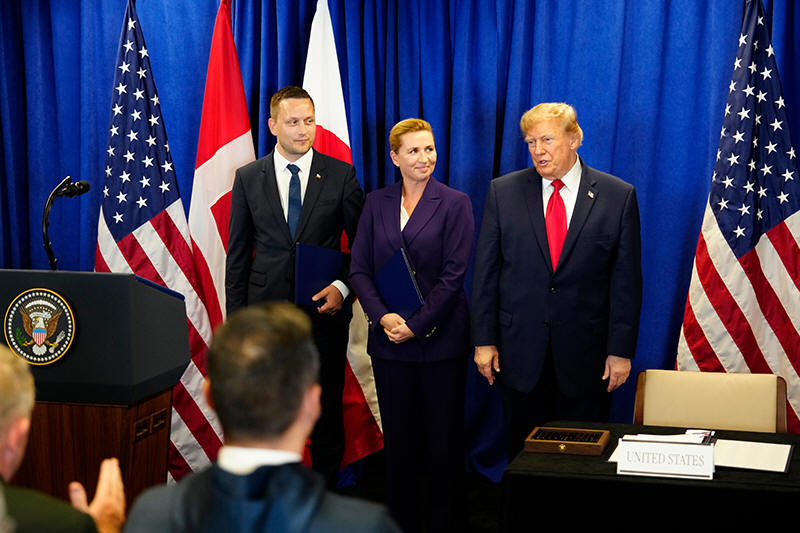
After his speech, Trump gathered with Danish Prime Minister Mette
Frederiksen and Greenlandic Prime Minister Jens-Frederik Nielsen on the
sidelines of the General Assembly to sign a new security agreement.
The deal, announced last week, came together after Trump repeatedly
threatened to “take over” Greenland, a territory of NATO-ally Denmark,
by military force if necessary. Trump said Tuesday the U.S. will
immediately begin the process of developing a larger military presence
in Greenland including “building two very major military bases.”
Under the deal, Greenland remains Denmark’s territory.

[to top of second column]
|
Denmark's Prime Minister Mette Frederiksen, Greenland's Prime
Minister Jens-Frederik Nielsen, left, and US President Donald Trump
at the signing ceremony of a security deal between the U.S., Denmark
and Greenland at United Nations headquarters, Tuesday, Sept. 22,
2026. (Mads Claus Rasmussen/Ritzau Scanpix via AP)

Trump also held talks on the sidelines of the General Assembly with
new British Prime Minister Andy Burnham, Japanese Prime Minister
Sanae Takaichi, South Korean President Lee Jae Myung, Ukrainian
President Volodymyr Zelenskyy, and Venezuela’s acting President
Delcy Rodríguez.
Trump and Rodriguez's engagement during a Tuesday evening reception
was the first meeting between the two since Trump in January ordered
the mission to capture Maduro and sweep him off to New York City to
face federal narcoterrorism and drug trafficking charges. Maduro’s
lawyers have objected to the U.S. military action that snatched him
from power.
Iran war looms large at General Assembly
The visit to the U.N. comes as Trump's foreign policy approach —
particularly his decision to start a war with Iran — has become a
drag on his fellow Republicans' hopes of retaining control of both
chambers of Congress during the coming midterm elections.
Nevertheless, Trump made the case in his speech that the world is
better off for his leadership.
“I have no interest in leaving dangers to grow for another day,"
Trump said.
In last year's address at the U.N., Trump claimed the U.S. had
“demolished” Iran's nuclear capabilities after he ordered the June
2025 bombardment of three key facilities.
He returned to the General Assembly nearing the seven-month mark of
a new war against Iran that he insists is necessary to address a
nuclear threat posed by the Islamic Republic.
The war has grown more complicated even though strikes by the United
States and Israel have killed much of Iran's top leadership and
destroyed its air force and navy, while a U.S. blockade of Iranian
oil has left Tehran in economic shambles.
The energy market continues to be spooked by the war and oil prices
remain elevated. Saudi Arabia earlier this month shuttered a key
pipeline that acted as a relief valve for oil blocked in the Gulf.
The kingdom made the move after the pipeline came under attack by
Iran-backed militants in Iraq.
At the same time, territorial grabs by the Yemen-based Houthi
rebels, another Iranian-backed group, near the Bab al-Mandab Strait
has now made it treacherous for oil carriers to use that Red Sea
shipping lane.

Trump's frustration with Russia-Ukraine war mounts
In his address, the president also touched on Russia's continuing
war against Ukraine — a conflict that during his 2024 campaign he
predicted would be resolved on Day One of his second term. He once
again expressed hope that the conflict will soon be resolved.
Trump hasn't obscured that his patience is being tested by Ukraine's
targeting of Russia's diesel refineries — an issue that's added to
the global oil markets' volatility — and Russia's targeting of
Ukraine's energy grid.
Trump noted that last week he signed a new sanctions bill targeting
Moscow. It empowers him to impose up to 100% tariffs on the top five
importers of Russian oil or natural gas.
The legislation includes an exception for countries that import less
than 15% of Russia’s natural gas exports and have taken significant
steps to reduce those imports. Trump, however, has yet to enact the
stiff penalties.
“If necessary, I will have to use them,” Trump said. “It’s time to
stop the killing.”
___
Associated Press Diplomatic Writer Matthew Lee contributed to this
story.
All contents © copyright 2026 Associated Press. All rights reserved |