FDA panel endorses first-of-a-kind cancer blood test from Grail
[September 24, 2026]
By MATTHEW PERRONE and LAURAN NEERGAARD
WASHINGTON (AP) — Federal health advisers on Wednesday endorsed a blood
test designed to spot signs of various cancers in apparently healthy
people while warning that it's far from clear how well the technology
works.
Grail Inc.’s Galleri test doesn't diagnose cancer but instead, with a
single blood draw, looks for a signal that someone may have one of a
long list of tumors. Those who receive a positive result need additional
care to tell if they're really sick.
The Food and Drug Administration's advisory panel voted 7-2, with one
abstention, that the DNA-based test offers more potential benefits than
risks, such as causing false assurances or raising false alarms. The
positive vote came even as the panel raised many questions about the
technology that need more study.
“Perhaps my yes is a hopeful rather than an accurate one,” said Dr.
Victor van Berkel of UofL Physicians in Louisville, Kentucky, describing
how more research is needed even if the test is rolled out. “If we can
find more early-stage cancers in the population that we can’t screen for
currently, that will end up having benefit.”
The vote followed two earlier votes in which the experts affirmed that
the test appears safe and effective for use by people age 50 and older.
Lots of companies are studying such blood tests and Wednesday's vote
marks the first time a federal advisory group has backed the
experimental approach. The FDA isn't bound by the advice but if it
agrees, it could pave the way for widespread U.S. adoption of a
long-sought way to find more cancers earlier. A final decision is
expected in a few months.
Today there are a handful of recommended cancer screenings, such as
mammograms and colonoscopies, that look for one kind of tumor at a time.
Those tests are designed to spot tumors in their early stages, when
they’re easier to treat, and the panel balked at using that term for
Grail’s test — saying it failed to show effectiveness for “early
detection.”

The experts also came up with a list of precautions that doctors and
potential patients to be told, including: The test would need to be used
in addition to today’s routine cancer screenings, not as a replacement.
A negative test doesn’t guarantee you don’t have cancer. And it will
take more study to prove if the test is as beneficial as mainstay cancer
screenings like mammograms.
People in the U.S. can already buy the Galleri test — typically by
paying $700 or more in cash. But FDA approval would likely widen
availability by opening the door to coverage from Medicare and private
insurers.
FDA staffers and other outside experts spent hours debating the
potential downsides to the technology.
[to top of second column]
|
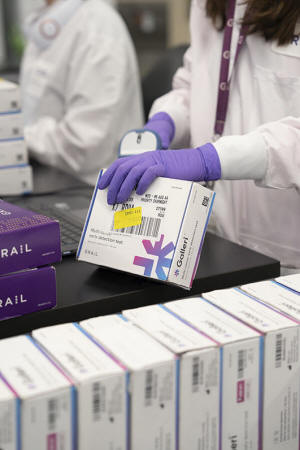
This undated photo provided by Grail Inc. on Tuesday, Sept. 22,
2026, shows an employee scanning a Galleri cancer screening test.
(Grail Inc. via AP)

Risks include that the test will miss a significant number of real
cancers while also flagging a potential cancer in patients who are
healthy. The test also was less accurate at detecting early-stage
cancers, when treatment is easier and more likely to benefit patients.
Grail also didn’t provide data showing that screening with its test led
to fewer cancer deaths, a metric that would have required years of
follow-up.
Representatives for Grail argued that its test is a leap forward because
it can pick up signs of more than 50 cancers, including dozens for which
there are no screening options, such as liver and ovarian cancer.
“Patients want opportunity, they want options,” said Dr. Mylynda Massart
of the University of Pittsburgh, who presented on behalf of Grail. “They
want the chance to fight their disease while the chance to survive is
possible.”
Grail’s primary study in 140,000 older adults showed that its test
detected about one third of cancers diagnosed over a one-year period.
About two-thirds of patients who received a “cancer signal detected”
were later confirmed to have cancer.
But FDA reviewers at the meeting flipped the company’s data to emphasize
the potential downsides of that performance. The agency’s chief reviewer
pointed out that the test missed 2 of 3 cancers that were diagnosed over
the coming year, giving false reassurance to many patients.
Consumer advocates warned that patients might ignore early signs of
cancer after receiving an all-clear from DNA testing test.
“When they start having symptoms there will be tendency to delay going
to the doctor — just a little bit — and that could be deadly,” said
Diana Zuckerman of the nonprofit National Center for Health Research,
who spoke during a public comment period. “They will be told to continue
other screening, but will they?”
All contents © copyright 2026 Associated Press. All rights reserved |