Residents near Maui wildfires show elevated metals linked to impacted
lung health, study says
[September 29, 2026]
By ALEXA ST. JOHN
Metal mixtures found in the leftover smoke, ash and debris from the
deadly 2023 Maui wildfires were harmful to the lung health of people
living nearby long after the burning ended, a new study says.
The work shows that major wildfires, which are worsening with the
planet’s warming, could have lasting effects beyond immediate exposure.
Post-wildfire air quality needs to be monitored longer term, the
research suggests, and recovery efforts need to consider what might
remain in contaminated soot, residue and dirt well after burning stops.
The wildfires, caused by wind spreading a brushfire spurred by downed
power lines, burned on the Hawaiian island of Maui in August 2023,
destroyed the town of Lahaina and killed more than 100 people. They were
among the deadliest in U.S. history.
New research published in the journal Proceedings of the National
Academy of Sciences on Monday found higher metal levels, associated with
respiratory harm, in nearby residents up to a year and a half after the
fires.
University of Hawaii researchers studied the urine of 1,400 adults and
found substantially elevated concentrations of metals such as arsenic,
cadmium, copper and antimony.
Burned buildings, cars and electronics can release harmful chemicals
These metals could be the result of burned buildings, vehicles,
electronics and other materials lost in the wildfires, the researchers
say. They can cause a different human impact than simply the burned
vegetation that is typically studied after fires of this magnitude.

“What we’re dealing with, especially in the aftermath of what we
experienced in Lahaina, is a much more complicated mixture of these
chemical exposures,” said Alika Maunakea, the study’s co-author and an
anatomy, biochemistry, and physiology professor at the University of
Hawaii, Manoa.
The researchers found antimony nearly 40 times higher in the Maui
participants than U.S. biomonitoring data. They found manganese 3.8
times higher, barium 2.3 times and arsenic 2.2 times.
Having more metals in the body was more likely to result in abnormal
lung function, such as having less breathing capacity and difficulty
moving air in and out of one’s lungs, during standard breathing tests,
the study found.
Those lung effects aligned with the geographic distribution of smoke and
ash; those nearest to Lahaina, and Wailuku and Kahului, experienced a
different impact than in those near Kula.
“It’s really important to identify potential sources of these exposures
and to mitigate and reduce potential risks for re-exposures that might
be contributing to these effects,” Maunakea said. “What happens to the
land and environment can shape what people breathe, take into their
bodies, and develop over time. The consequences of that can unfold over
many years.”
[to top of second column]
|
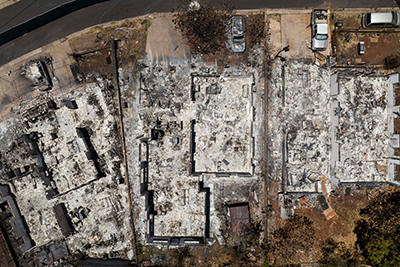
The remains of homes are visible in the aftermath of a wildfire in
Lahaina, Hawaii, Aug. 22, 2023. (AP Photo/Jae C. Hong, file)
 Warming planet can worsen
wildfires
Wildfires are getting larger, more intense, faster-moving and more
frequent in certain parts of the globe, experts say, in part due to
the warming and drier weather associated with climate change.
Human-caused climate change has upped the likelihood of many major
fires around the world in recent years and led to fires in regions
that typically do not see them as often.
The researchers did note a limitation of the study in that it cannot
assess exactly how much of the impact came directly from the
wildfires versus chronic or other exposures — such as Hawaii’s
geology, diet, historic agricultural and industrial activity and
environmental sources — given there is no comparable data from
before August 2023.
However, previous studies have also found significant long-term
human impacts from wildfires and other environmental crises. The
impacts have included lung issues and mental health issues such as
depression.
“This is bigger than wildfires. These climate-related disasters can
change the environment in ways that continue after the immediate
emergency is over,” said Ruben Juarez, study co-author and professor
of health economics at the university. “Floods, hurricanes, fires,
and other disasters definitely can disturb soil, debris, buildings,
and legacy contaminants that we have in Hawaii, creating these
pathways for exposure. … Disaster response should not stop when
visible danger is gone.”
Dr. Kekoa Taparra, a physician and assistant professor who studies
chronic diseases at the University of California, Los Angeles, said
the research expands our understanding of the health burden of the
fires, particularly over an extended period.
“This type of work echoes that climate-related disasters affect
human health well beyond the immediate injuries and deaths we see
during the event itself,” said Taparra, who was not involved in the
study released Monday but has studied the health impacts of
disasters. “Historic wildfires in Lahaina and even Los Angeles have
highlighted how these disasters can produce longer-lasting
consequences through displacement, disruption of healthcare and
social networks, environmental exposures, and potentially increased
mortality.
“As these events become more frequent and severe, understanding and
measuring their full health impact will be essential to building
more resilient communities and health systems.”
___
Alexa St. John is an Associated Press climate reporter.
All contents © copyright 2026 Associated Press. All rights reserved
 |