Taxpayers have funded nearly $1.5M in pro-Trump ads. Criticism is
mounting, including from the GOP
[September 29, 2026]
By ALI SWENSON
The White House has spent days fiercely defending three taxpayer-funded
advertisements that glorify President Donald Trump and are nearing at
least $1.5 million in public spending, calling them public service
announcements like those used in past administrations.
“Don’t let the Fake News get away with their lies about our epic Public
Service Announcements that have been running on tv,” White House
communications director Steven Cheung posted on X on Sunday.
But the Republican administration's ads attracted mounting criticism on
Monday, including from members of Trump’s own party.
“It shouldn’t be paid for with taxpayer dollars,” Senate Majority Leader
John Thune, R-S.D., told reporters.
“It would not have been something that I would have done. And I know
that the White House is not covered by the same guidance that we are,
but it’s not something that I would have done," said Sen. Mike Rounds,
another South Dakota Republican.
Multiple legal experts consulted by The Associated Press said the ads
appear to run afoul of federal statutes, including a law against
congressionally appropriated funds being used for “publicity or
propaganda” and a law that limits the partisan political activities of
government employees.

They said the new ads, which are airing on network and cable TV and
streaming, differ from other administrations’ PSAs because they aren’t
designed to help Americans access any specific program.
“You watch all three ads, they’re sheer propaganda,” said Richard
Painter, a former White House ethics czar under Republican President
George W. Bush. “This is increasingly looking like what authoritarian
governments do to promote their leaders.”
The heightened scrutiny comes as the Trump administration has increased
spending on the ads and bought time on popular TV shows, including
college football and National Football League programming. It remains
unclear which part of the government is supplying the funds.
With both chambers of Congress led by Republicans, any oversight would
likely have to come from Trump's allies, decreasing the likelihood of
hearings or other accountability efforts before November's midterm
elections.
Three ads have aired in less than a week, totaling well over $1M
The first ad in the campaign, which began airing last Wednesday,
features clips of Trump talking about defeating communism interspersed
with onscreen text promoting the “largest tax cuts in history,”
“reigniting American manufacturing” and a call to “defend law and order
and police.”
Later in the week, a second ad began running, showing scenic videos of
Mount Rushmore at night with quotes and clips from Trump’s Fourth of
July weekend speech there honoring the country’s 250th anniversary.
The latest of the ads, a spot first aired over the weekend, is virtually
identical to an ad for Trump’s Republican reelection campaign in 2024.
It shows him walking down a hallway as his voice can be heard warning of
a “final battle” against “globalists” and “warmongers.”
All three ads end with a message that says: "Paid for by the U.S.
Government.” The White House hasn't responded to inquiries about which
part of the government is paying.
According to AdImpact, which tracks media spending, the spots have so
far cost more than $1.4 million and run across a wide range of TV
networks around the country. The actual amount spent could be
significantly more, depending on whether networks classified the ad as a
political ad.

The ads are different from past PSAs, experts say
In defending the campaign, the White House published a list of PSAs from
recent Democratic and Republican administrations.
Among the examples it cited were Bush’s Republican administration
touting a Medicare law, Barack Obama's Democratic administration
promoting Affordable Care Act subsidies and Joe Biden's Democratic
administration running ads promoting COVID-19 vaccinations.
[to top of second column]
|
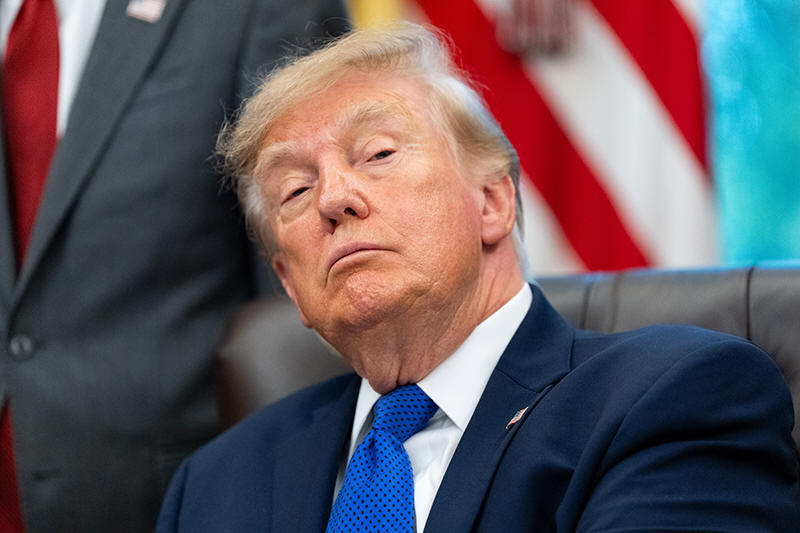
President Donald Trump speaks in the Oval Office of the White House,
Monday, Sept. 28, 2026, in Washington. (AP Photo/Alex Brandon)
“The announcements are very clearly not campaign ads; President
Trump is not on the ballot and there is no call to action,” the
White House wrote. “Instead, the announcements are a reminder for
Americans to love their country and know why it’s worth defending —
at home, at the border, and abroad.”
Kathleen Clark, a legal ethics professor at Washington University in
St. Louis, said in her view the new ads differ from the examples the
White House provided because they aren’t aimed at helping members of
the public benefit from specific government programs.
“These ads are nothing more than government propaganda, aimed at
helping Trump,” she said.
Painter, who joined the Bush administration after the Medicare PSAs
went out, said that ad campaign toed the line on appropriateness
because it included misleading information about Medicare Part D.
But he said Trump's campaign is a far more egregious violation of
the statute that blocks congressionally appropriated money from
being spent on publicity or propaganda.
“There's nothing in here about a particular policy that's at all
focused," Painter said of Trump's ads. “One of them is just about
the evils of the deep state. Another one of them is about communists
and Marxists.”
In its support for the ads, the White House also referenced the
administrations of President Woodrow Wilson and President Franklin
D. Roosevelt, both of whom used posters, radio and film to rally the
country during World Wars I and II.
James Kimble, a communication professor at Seton Hall University who
studies domestic propaganda, said it's true that Wilson's Democratic
administration used propaganda to rally Americans. But he said most
Americans no longer view its actions in a positive light.
“By almost any objective measure, looking back, we find what they
did pretty repulsive," he said.

Skepticism of the campaign grows on the Hill
Top Democrats on the Senate and House appropriations committees last
week wrote to the White House demanding the ads be taken down and
requesting more information on how much money was spent to create
and air them.
In the days since, more than a dozen Democrats and a handful of
Republicans have spoken up to further criticize the ads. Senate
Minority Leader Chuck Schumer called the latest ad “an absolute
violation of what a democracy is supposed to look like.”
“Americans sat down to watch football, not to be force-fed Trump’s
propaganda on their own dime,” he said in a Senate floor speech
Monday.
Sen. John Kennedy, a Republican from Louisiana, said on CBS's “Face
the Nation” on Sunday that no public official should spend public
money on private ads for themselves.
And Rep. Thomas Massie, a Kentucky Republican who lost his primary
to a Trump-backed challenger, had his own harsh words for the
administration on Monday.
“Don’t worry, using taxpayer dollars to run ominous campaign ads of
the President has been done before and is completely legal… in
banana republics,” he wrote in an X post.
The Republican chairs of the Senate and House appropriation
committees didn't respond to requests for comment.
___
Associated Press writers Mary Clare Jalonick and Steven Sloan
contributed to this report.
All contents © copyright 2026 Associated Press. All rights reserved |